
Formula 1 Tire Compounds Explained: C0 to C5, Color Coding, and Race Strategy
Pirelli, the exclusive Formula 1 tire supplier since 2011, provides six dry slick compounds ranging from the ultra-hard C0 to the hyper-soft C5. For each Grand Prix, three of these compounds are nominated and assigned the familiar color codes: white for Hard, yellow for Medium, and red for Soft. Teams receive 13 slick sets per driver and must use at least two different dry compounds during a dry race.
The core strategic challenge is balancing a tire’s initial grip against its degradation over laps—a decision that can determine race victory or defeat. This guide explains the full compound spectrum, the grip-durability trade-off, and how teams craft their tire strategy for 2025 and beyond.
- Pirelli supplies six dry compounds (C0 hardest to C5 softest), with three color-coded options (White, Yellow, Red) nominated for each Grand Prix.
- Softer compounds (Red) provide higher grip but degrade in 6-8 laps; harder compounds (White) last 20-40+ laps but are slower per lap.
- Each driver gets 13 slick tire sets per weekend and must use at least two different dry compounds during the race.
- Tire selection is a track-specific strategy, influenced by asphalt roughness, expected degradation, and weather conditions.
Formula 1 Tire Compound Range: The C0 to C5 Spectrum and Color Coding
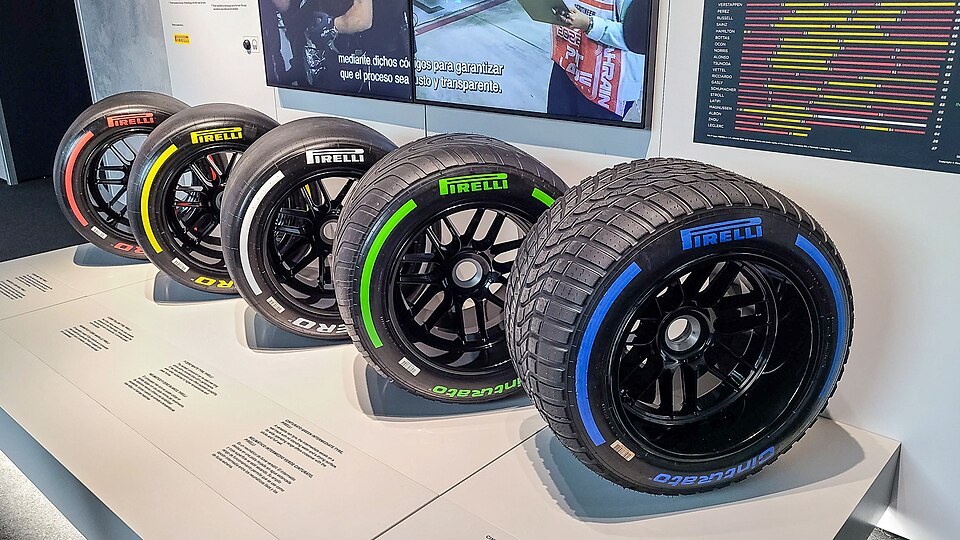
Formula 1’s tire system is built on a standardized range of six dry slick compounds, each with a unique rubber formulation that defines its performance characteristics. These compounds, designated C0 through C5, form a spectrum from maximum durability (C0) to ultimate grip (C5). For each race, Pirelli—Formula 1’s sole tire supplier—selects three specific compounds from this range to be available to teams.
The hardest of the three receives white sidewalls (Hard), the middle gets yellow (Medium), and the softest gets red (Soft). This structure creates a consistent visual language while allowing flexibility to match track demands.
The Six Dry Slick Compounds: From Ultra-Hard C0 to Hyper-Soft C5
| Compound Code | Common Role | Sidewall Color | Primary Characteristic | Typical Use Case |
|---|---|---|---|---|
| C0 | Hard | White | Highest durability, excellent heat resistance | High-wear circuits like Silverstone, long stints |
| C1 | Hard | White | Very durable, low grip | Tracks with high abrasion, often the Hard nomination |
| C2 | Medium | Yellow | Balanced performance, moderate degradation | Most versatile, frequently used as Medium |
| C3 | Medium | Yellow | Good balance, excellent consistency | Popular choice for Medium, suitable for many circuits |
| C4 | Soft | Red | High grip, faster degradation | Qualifying performance, short stints |
| C5 | Hyper-Soft | Red | Maximum grip, shortest lifespan | Low-grip street circuits, extreme performance focus |
It’s important to note that the ‘Hard’, ‘Medium’, and ‘Soft’ labels are relative to the three compounds nominated for a specific Grand Prix. For example, at the 2025 Monaco Grand Prix, Pirelli nominated C3, C4, and C5. Thus, C3 was the Hard (white), C4 the Medium (yellow), and C5 the Soft (red).
At a more abrasive circuit like Silverstone, the nomination might be C1, C2, C3, making C1 the Hard, C2 the Medium, and C3 the Soft. This means the same compound code can represent different performance tiers depending on the race. Pirelli develops all six compounds through extensive testing—over 10,000 test hours and 70 prototypes—to ensure each offers a distinct performance window.
The slick tires measure 305/720-18 at the front and 405/720-18 at the rear, a size introduced with the 18-inch wheel regulation in 2022. These dimensions contribute to the tires’ behavior and degradation characteristics.
Color-Coded Selection: What White, Yellow, and Red Actually Mean for a Race Weekend
The color coding is a simple yet powerful communication tool. During a race weekend, the three nominated dry tires are instantly recognizable by their sidewall colors: white for the Hard, yellow for the Medium, and red for the Soft. These colors are fixed regardless of which specific compounds are chosen.
The selection of which three compounds to nominate is a strategic decision made by Pirelli based on data from previous events at the circuit, asphalt analysis, and expected weather. The goal is to create a performance spread that encourages varied strategies—typically, the Hard should be sufficiently durable for long stints, the Medium balanced, and the Soft fast but short-lived. In addition to the three slick compounds, Pirelli also provides the Cinturato Intermediate (green sidewall) for damp conditions and the Full Wet (blue) for heavy rain.
These wet-weather tires have fixed compounds and are not part of the C0-C5 nomination system. The color system allows fans, drivers, and engineers to quickly identify tire types at a glance, adding to the visual spectacle of Formula 1. For the 2025 season, Pirelli has refined the compounds to improve consistency and reduce unexpected degradation, building on lessons from the previous year.
Grip and Durability Trade-Offs: The Science of Tire Degradation
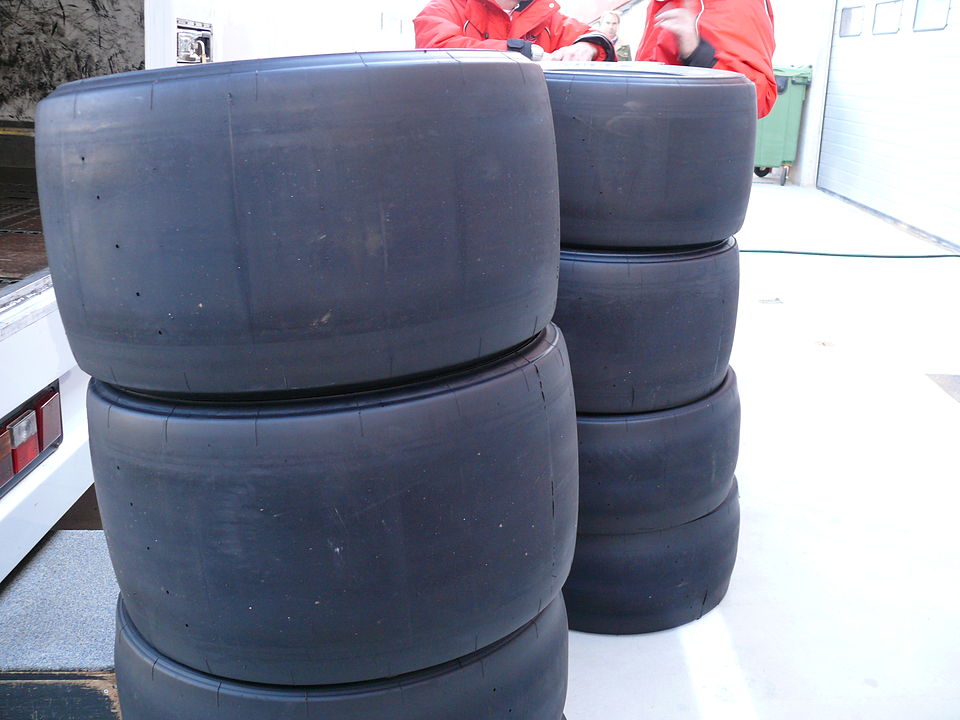
The heart of F1 tire strategy lies in the inevitable trade-off between grip and durability. A softer compound delivers higher cornering speeds but wears out faster; a harder compound lasts longer but is inherently slower.
Teams must quantify this trade-off to determine the fastest overall race time, not just the fastest single lap. The relationship between lap time and degradation is non-linear, and the optimal strategy often defies intuition.
The Lap-Time vs. Longevity Equation: Why Softer is Faster Until It Isn’t
- Peak Grip & Lap Time: The softest compound available (the Soft/red) offers the highest mechanical grip, enabling drivers to carry more speed through corners and achieve the fastest lap times. This makes it the tire of choice for qualifying and the opening laps of a stint when the rubber is fresh. On a typical circuit, the Soft can be 0.5-1.0 seconds per lap quicker than the Hard when new.
- Degradation Rate: Softer rubber compounds experience accelerated wear.
According to team data, a Soft tire can maintain its peak performance for only 6-8 laps before lap times increase by over 1.0 second per lap. Hard tires, by contrast, may stay within 0.2-0.5 seconds of their initial pace for 20-40 laps or more, depending on track conditions. The degradation curve is steepest in the first few laps and then gradually flattens, but never returns to the initial level.
- Total Race Laps Possible: The durability difference is stark.
A set of Soft tires might need replacement after 8-10 laps, while a Hard set can often complete 30-40 laps before significant performance loss. This directly impacts pit stop frequency and total race time. For a 50-lap race, using Soft tires exclusively would require 5-6 stops, while Hard tires might allow a one-stop strategy.
The strategic calculus is not simply ‘softer = faster’.
A tire that is 0.8 seconds quicker per lap but requires an extra pit stop (adding ~20 seconds) may actually result in a slower overall race time. Teams use sophisticated models to simulate total race duration based on degradation curves, pit stop losses, and fuel loads. The optimal strategy often involves using a slightly slower compound that allows for a longer stint and fewer stops, or a clever combination of two compounds that minimizes total time spent in the pits while keeping degradation within acceptable limits.
For example, a Medium tire that degrades moderately might allow a 25-lap stint with only a 0.3-second per lap drop-off, resulting in a lower cumulative time than a Soft that needs replacement after 8 laps. The key is to minimize the integral of lap time over the race distance, not to maximize any single lap.
The Optimal Working Window: Why 100°C is the Magic Number
All Formula 1 tires operate within an optimal temperature window, typically centered around 100°C (212°F) for the tread. Below this window, the rubber remains too hard to generate maximum grip; above it, the tire overheats, causing blistering and graining that reduces traction and accelerates wear. Achieving and maintaining this window is a critical challenge.
Track surface temperature, ambient conditions, car setup (including camber and tire pressures), and driving style all influence tire temperature. For instance, high-downforce circuits like Monaco help keep tires in the optimal range longer, while low-downforce, high-speed tracks like Monza can cause temperatures to spike rapidly. Drivers must “scrub” the tires on out-laps to bring them up to temperature, and teams adjust tire pressures by up to 0.5 psi depending on conditions.
Different compounds have slightly different optimal windows—softer tires often peak at slightly lower temperatures—but the ~100°C target is a universal benchmark. Pirelli’s development process includes rigorous testing to ensure each compound can reach and sustain this window for the intended stint length, providing consistent performance when it matters most. In 2025, Pirelli introduced a new C0 compound as the hardest option, with enhanced heat resistance to cope with the most abrasive circuits.
This compound can operate effectively at temperatures up to 110°C without significant degradation, making it suitable for tracks like Silverstone or Spa where energy loads are highest. Understanding and managing this working window is as important as the compound choice itself; a tire that is outside its optimal temperature range can be several seconds per lap slower, regardless of its inherent grip potential.
Race Strategy and Tire Selection: How Teams Use Their 13-Set Allocation
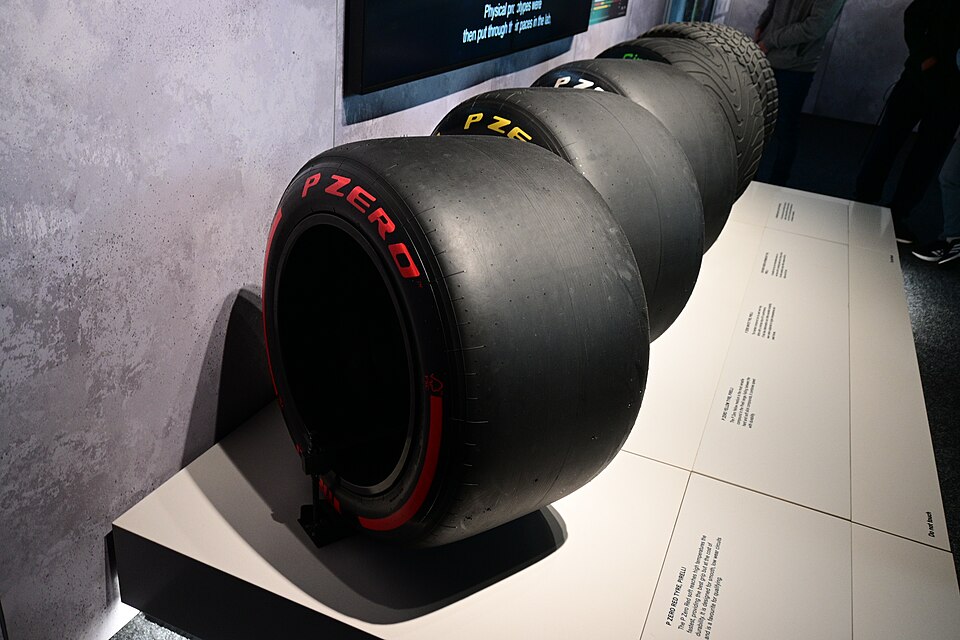
Each Formula 1 driver is allocated 13 slick tire sets per race weekend, along with up to 4 intermediate and 3 full wet sets if conditions require. Within this fixed allocation, teams must devise a strategy that complies with the FIA’s two-compound rule for dry races.
The process of selecting which compounds to use—and when—is a data-driven optimization that begins in free practice and culminates in the checkered flag. The allocation is identical for all drivers, but strategic choices about which specific sets to use—and when—create the tactical diversity that defines Formula 1.
The 13-Set Rule: Allocation Breakdown and the Mandatory Two-Compound Rule
The standard slick allocation consists of 2 sets of the Hard (white), 3 sets of the Medium (yellow), and 8 sets of the Soft (red). This distribution reflects the Soft’s role as the fastest compound for qualifying and early stints, but also its limited lifespan. The Hard, being the most durable, is reserved for longer runs.
The Medium provides a flexible middle ground. The FIA’s sporting regulations (Article 22.4) mandate that in a dry race, each car must use at least two of the three nominated dry compounds. This rule prevents teams from running a single compound for the entire distance, ensuring strategic variety and pit stop activity.
Consequently, every dry race requires at least one pit stop to change tires. Teams plan their stops around the degradation characteristics of each compound, aiming to minimize total race time while meeting the two-compound requirement.
The allocation is the same for all drivers, but the choice of which compounds to use for each stint—and the order of usage—creates the strategic chess match that unfolds on race day. Additionally, teams receive 4 sets of intermediate (green) and 3 sets of full wet (blue) tires, which can be used without restriction in wet conditions, but these do not count toward the two-compound rule in a dry race.
Track-Specific Selection: Why Monaco Needs Soft Tires and Silverstone Demands Harder Compounds
Track characteristics can completely invert the usual priority between grip and durability. Consider the contrast between Monaco and Silverstone:
- Monaco is a low-grip, twisty street circuit where mechanical grip is at a premium. The soft asphalt generates moderate wear, but the lap time advantage of the Soft (red) compound is substantial—often 0.5-1.0 seconds per lap faster than the Hard. Teams accept the high degradation (as little as 6-8 laps of competitive pace) because the alternative—running a harder compound—would sacrifice too much time in the tight corners. A typical strategy involves two stops, using Soft and Medium tires to manage the drop-off while maximizing mechanical grip.
- Silverstone, in contrast, features high-speed corners (Copse, Maggotts) that generate immense lateral forces, combined with an abrasive tarmac that wears tires quickly. Here, durability is paramount. The Hard (white) compound, despite being 0.3-0.6 seconds per lap slower than the Soft, can last 15-20 laps longer, enabling a one-stop strategy that minimizes total pit time.
The abrasive surface also causes higher thermal degradation, making the Hard’s heat resistance critical. A Soft tire would blister within a few laps at Silverstone’s high energies.
Other circuits follow similar logic: the smooth, low-energy Baku City Circuit often favors softer compounds due to low wear, while the high-downforce, high-energy Spa-Francorchamps typically requires harder tires to cope with the long, fast corners and variable weather.
Pirelli’s nomination for each Grand Prix reflects these track-specific demands, ensuring a strategic spread that challenges teams to find the optimal balance. For the 2025 season, Pirelli has also considered the evolving car designs under the 2022 ground-effect regulations, which produce less turbulent air and affect tire cooling, further influencing compound selection.
Building the Race Plan: From Free Practice to the Checkered Flag
The process of selecting which compounds to use—and when—is a data-driven optimization that begins in free practice and culminates in the checkered flag. The allocation is identical for all drivers, but strategic choices about which specific sets to use—and when—create the tactical diversity that defines Formula 1.
Sprint Weekends: When a sprint race format is used (typically on Saturday), the allocation changes: drivers have fewer slick sets (usually 12 instead of 13), and the Sprint Shootout determines the grid for the sprint, which in turn influences tire choices for the main race. This adds another layer of complexity to the planning, as teams must also consider the sprint race strategy when allocating tires.
- Friday (FP1 & FP2): Teams conduct long-run tests on all three nominated compounds. Drivers complete stints of 15-20 laps to measure degradation curves—how lap times drop as tires wear. Engineers collect data on tire temperature, pressure, and wear patterns. This information feeds into simulation models that predict race pace for each compound over a full distance, accounting for fuel load and traffic. Teams also test different wing settings to see how aerodynamic load affects tire degradation.
- Saturday (FP3): The focus shifts to qualifying setup. Teams typically use the Soft tire for fastest laps, fine-tuning aerodynamic balance and mechanical grip. They also perform short out-laps to assess how quickly tires reach optimal temperature, which influences the first stint choice. Data from FP3 helps refine the degradation models with more representative fuel loads.
- Qualifying (Q1, Q2, Q3): The pivotal moment arrives in Q2, where the top 10 drivers must start the race on the tires they used to set their fastest Q2 time. Teams must decide: qualify on the Medium (preserving Soft sets for the race) or on the Soft (ensuring a better grid position but sacrificing a Soft set). This choice heavily influences the first stint and overall strategy. A lower grid position might force an earlier pit stop, while a higher position allows more flexibility.
- Race: The opening stint often uses the Medium compound, as it offers a compromise between grip and longevity, allowing teams to evaluate real-world degradation. Based on the data, they plan pit stops: a one-stop might switch from Medium to Hard; a two-stop could use Soft-Medium-Soft or similar. The mandatory two-compound rule ensures at least one tire change to a different compound. Teams monitor live tire data and adjust strategy if degradation deviates from predictions—for example, if a Hard tire lasts longer than expected, they might extend the stint and skip a planned stop. Driver feedback is crucial; a driver who can manage tires better may allow a longer stint on a softer compound.
- Sprint Weekends: When a sprint race format is used (typically on Saturday), the allocation changes: drivers have fewer slick sets (usually 12 instead of 13), and the Sprint Shootout determines the grid for the sprint, which in turn influences tire choices for the main race. This adds another layer of complexity to the planning, as teams must also consider the sprint race strategy when allocating tires.
Throughout the weekend, teams rely on Pirelli’s data and their own simulations to build a comprehensive race plan. The goal is to minimize total time lost to pit stops and slower laps while maximizing the time spent on the fastest available compound. The introduction of the budget cap has also influenced tire strategy, as teams must balance the cost of tire usage with performance gains, though tire supply is still provided free by Pirelli.
For a deeper dive into how Pirelli manages tire allocation across the season, see our guide on Formula 1 tire compound strategy. The 2026 technical regulations will bring further evolution to the 18-inch tire package, requiring teams to adapt their models and strategies once again.
For a deeper dive into how Pirelli manages tire allocation across the season, see our guide on Formula 1 tire compound strategy. The 2026 technical regulations will bring further evolution to the 18-inch tire package, requiring teams to adapt their models and strategies once again.
The strategic depth of Formula 1 tire selection often surprises casual fans: the fastest tire on a single lap is rarely the optimal choice for the entire race. The real art lies in managing the delta between a compound’s initial lap time and its degradation curve—finding the combination that yields the lowest cumulative race time, not just the fastest opening stint. For the next Grand Prix you watch, observe the top teams’ first pit stop.
Note which compound they choose for their opening stint; this reveals their predicted degradation model and forms the foundation of their entire race plan. The color of the tire matters less than the strategy it serves.
As Pirelli continues to evolve the C0-C5 range alongside the new 18-inch wheel formula—refined under the 2026 technical regulations—the strategic puzzle will shift, demanding even more precise data and adaptability from teams. In the high-stakes world of professional racing, tire strategy remains a decisive factor that separates winners from the rest. For a deeper look at how drivers and teams approach these challenges, explore insights from Sarah Moore Racing on professional racing.
