
Drafting in NASCAR reduces trailing car drag by 20-30% by exploiting the lead car’s slipstream. This fundamental technique is essential for gaining speed on superspeedways like Daytona and Talladega.
Key methods include side drafting to disrupt opponents, tandem drafting for acceleration, and strategic pack management. Mastering these allows drivers to conserve momentum, execute passes, and navigate high-speed packs safely.
- Drafting reduces trailing car drag by 20-30% when cars stay within one second of the leader.
- Side drafting increases a competitor’s drag while giving a small speed boost to the drafting car.
- Tandem drafting uses bumper-to-bumper contact for acceleration, but the Next Gen car has reduced its effectiveness.
How Do NASCAR Drafting Techniques Reduce Drag by 20-30%?
The ‘Hole in the Air’ and One-Second Gap: Core Mechanics of Drafting
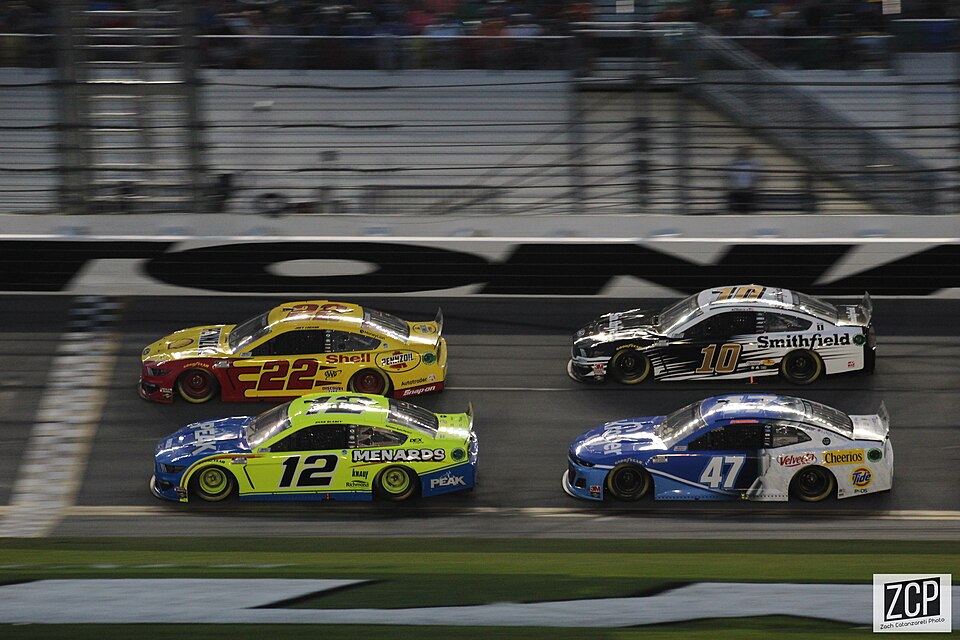
Drafting reduces drag by 20-30% when a trailing car stays within one second of the lead car (AIO). This happens because the lead car pushes air aside, creating a low-pressure zone or “hole in the air” behind it. The trailing car enters this zone, facing significantly less air resistance.
The one-second gap is critical—beyond this distance, the slipstream weakens and drag reduction drops sharply. Think of it like a cyclist drafting in a peloton: the closer you are, the more energy you save. In NASCAR, this translates directly to higher speeds with the same throttle input, making it a cornerstone technique for superspeedway racing.
Bottom Line Running: Momentum Conservation on Superspeedways
Running the bottom line on superspeedways provides the shortest path and helps maintain momentum through turns (AIO). This strategy is vital at tracks like Daytona and Talladega where every inch of track matters.
- Shortest distance: The bottom lane is the geometric shortest route around the oval, reducing total distance per lap.
- Momentum preservation: Staying low in turns minimizes lateral movement, helping cars carry speed without scrubbing off momentum.
- Drafting benefits: The bottom line often allows cars to tuck into the slipstream of leaders more easily, especially on exit.
- Examples: At Daytona, drivers frequently run the bottom in turns 1 and 2 to set up passes on the backstretch. At Talladega, the bottom line through the tri-oval is preferred for drafting slingshots toward the finish.
By combining bottom line running with drafting, drivers can achieve faster lap times while conserving fuel and tires—a key advantage in long superspeedway races.
Side Drafting vs Tandem Drafting: Key Techniques for Superspeedways
Side Drafting Mechanics: Breaking Air Over Opponent’s Spoiler
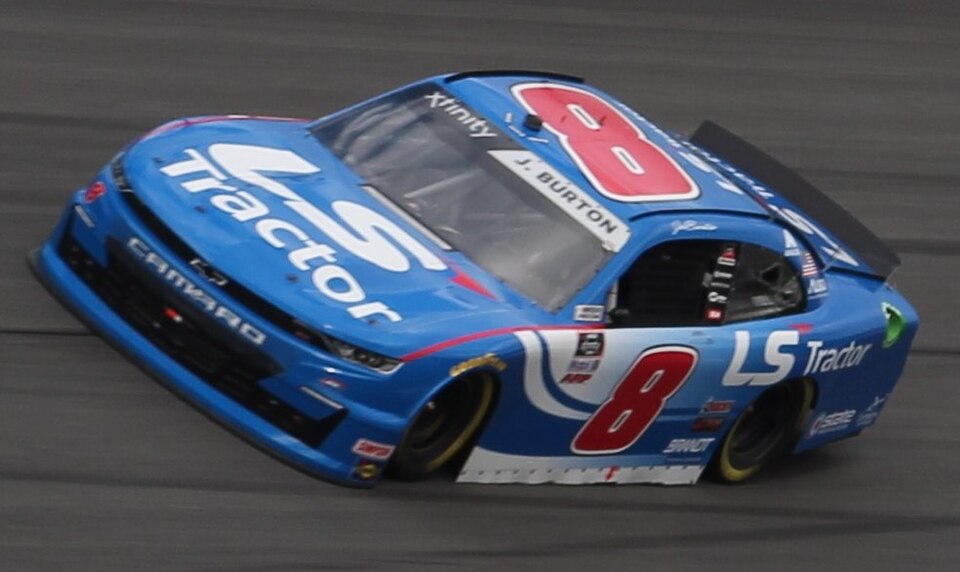
Side drafting involves positioning your car’s front quarter-panel near the opponent’s rear quarter-panel to disrupt airflow over their spoiler (AIO). This technique increases the opponent’s drag while providing a small speed boost to the drafting car.
- Positioning: The trailing car moves up alongside the leader’s rear, almost touching quarter-panels.
- Effect: This blocks smooth airflow over the leader’s rear spoiler, creating turbulent air that increases their drag coefficient.
- Speed advantage: The trailing car gains a few mph from cleaner air, enough to complete a pass.
- Usage scenarios: Commonly used for outside passes on superspeedways, or to break away from a pack by slowing a specific competitor.
Side drafting is a tactical tool—it doesn’t provide massive speed gains like tandem drafting, but it directly handicaps an opponent, making it valuable in close racing.
Tandem Drafting: Bumper-to-Bumper Pushing and Next Gen Car Changes
Tandem drafting involves one car pushing another on the bumper for increased speed and efficiency (AIO). However, the Next Gen car has made this technique less prevalent than in previous eras (AIO).
The process relies on direct contact: the trailing car lines up bumper-to-bumper and physically pushes the lead car, reducing drag for both and allowing higher speeds. This was particularly dominant at Daytona and Talladega in the pre-2022 car.
| Aspect | Old Car (Pre-2022) | Next Gen Car (2022-Present) |
|---|---|---|
| Effectiveness | Very high; often created two-car tandems that could dominate packs | Moderate; less stable, harder to maintain contact |
| Design Influence | Simpler bumpers allowed easier pushing | Reinforced, less flexible bumpers reduce pushing efficiency |
| Safety Impact | Higher risk of spins and crashes due to aggressive contact | Reduced risk but still present; NASCAR discourages excessive pushing |
| Strategic Use | Common for breaking away from main pack | Used situationally; pack racing more prevalent |
The Next Gen car’s aerodynamic changes and stiffer structures have diminished tandem drafting’s dominance, shifting focus back to larger pack management and side drafting techniques.
Superspeedway Pack Dynamics: Managing Large Groups at Daytona and Talladega
Pack Management: Larger Groups Achieve Higher Cumulative Speeds
Pack management is crucial because larger packs run faster than smaller groups due to cumulative drag reduction (AIO). In a dense pack, each car (except the leader) benefits from the slipstream of the car ahead, creating a chain reaction where the entire group moves faster than isolated cars or small pairs. This is why at Daytona and Talladega, the “big pack” is often the fastest place on track.
However, pack racing introduces significant danger—the “big one” multi-car wreck can end races instantly. Strategies for staying in the pack include: avoiding the front until late in the race, working with other drivers to maintain position, and staying alert to brake checks or sudden moves. Effective pack management balances the speed advantage with the heightened risk, making it a decisive skill for superspeedway success.
Technical Strategies: Grill Taping and A-Post Flap Impact on Drafting
Drivers use technical adaptations like grill taping and the A-Post Flap to optimize drafting performance at superspeedways. These modifications affect aerodynamics and engine cooling, requiring careful trade-offs.
| Technique | Purpose | Benefits | Risks |
|---|---|---|---|
| Grill Taping | Reduce air entering the engine bay to minimize drag | Lower drag coefficient, higher top speed | Engine overheating, especially in hot conditions or during long green-flag runs |
| A-Post Flap | Safety device that alters airflow over the windshield | Prevents cars from lifting in collisions, improves stability | Changes aerodynamic behavior, can reduce effectiveness of certain drafting moves |
Grill taping is a classic superspeedway trick—teams cover part of the front grille with tape to block airflow, reducing drag but risking engine temperatures. The A-Post Flap, mandated for safety, disrupts laminar airflow over the car’s top, which inadvertently changes how cars handle in drafts, sometimes making side drafting less predictable. Drivers must adapt their techniques to these factors during races.
Mastering NASCAR drafting techniques—from the core “hole in the air” principle to pack dynamics—is essential for competing at superspeedways. The most surprising insight is that larger packs are significantly faster due to cumulative drag reduction, making pack management a strategic necessity rather than just a safety precaution. For drivers looking to develop drafting feel, a practical step is to practice maintaining a consistent one-second gap in sim racing platforms.
This builds the spatial awareness needed to exploit slipstreams effectively while avoiding collisions in real-world high-speed packs. These skills are foundational for any competitor in professional racing, where aerodynamic efficiency often determines the outcome.
