
Physics of racing: weight transfer, aerodynamics, G-forces. F1 cars generate 3x weight in downforce; drivers face 4-6.5G cornering. These three core principles govern every aspect of racing performance.
Weight transfer shifts the car’s balance during acceleration, braking, and cornering, affecting tire grip. Aerodynamics creates downforce to push the car down, but also produces drag and dirty air that complicates racing.
G-forces are the intense lateral forces drivers endure in high-speed corners. Together, they form the foundation of racing physics that engineers and drivers must master to extract maximum speed safely.
- Weight transfer shifts up to 60% of a car’s load to the front tires during hard braking, maximizing stopping power (Allen Berg Racing Schools).
- Aerodynamic downforce in 2024-2025 F1 cars exceeds three times the vehicle’s weight, achieved through ground-effect venturi tunnels (The Race, 2025).
- Cornering G-forces reach 4G to 6.5G, making drivers’ heads feel like 30 kg weights (Mercedes-AMG F1, 2024).
How Does Weight Transfer Control Racing Performance?
Weight transfer is the shift of a car’s mass from one set of wheels to another during acceleration, braking, or cornering. This phenomenon directly determines how much grip each tire has available. Understanding weight transfer is fundamental for both drivers and engineers because it affects every corner entry, exit, and straight-line maneuver.
The physics behind it is straightforward: inertia resists changes in motion, causing the car’s center of mass to move relative to the wheels. This redistribution of load changes the normal force on each tire, which in turn changes the maximum friction each can generate before slipping.
Braking Weight Transfer: Front Tires Carry Over 60% of Load
When a driver hits the brakes, the car’s inertia wants to keep moving forward. This pushes the mass toward the front of the vehicle. As a result, the front tires bear a much larger share of the total weight.
According to Allen Berg Racing Schools, hard braking can shift over 60% of the car’s load onto the front tires. This increased normal force dramatically boosts the front tires’ braking grip because friction force is proportional to the normal force. Think of stopping a bicycle: when you squeeze the front brake hard, the bike’s weight shifts forward, making the front tire dig into the pavement and stop more effectively.
Race cars exploit this principle with powerful brake systems, but the downside is that the rear tires lose load and can lock up more easily if not balanced correctly. Drivers must modulate brake pressure to keep all tires working at their peak friction circle.
Cornering Weight Transfer: Outside Tires Gain Load for Grip
During cornering, the centrifugal force pushes the car outward. This causes weight to transfer to the outside tires. For example, when turning left, the car’s mass shifts to the right side tires.
The outside front and rear tires become more heavily loaded, increasing their normal force and thus their potential cornering grip. This is why a car can corner faster when the weight is properly distributed—the tires with the most load can generate more lateral force before reaching the friction limit. The principle from vehicle dynamics shows that cornering shifts load to the outside tires, enhancing grip through the friction circle.
Engineers design suspension systems to manage this transfer, maintaining tire contact with the road surface even as loads change dramatically. A well-tuned car will allow both outside tires to reach their limit simultaneously, maximizing cornering speed without causing understeer or oversteer.
Acceleration Weight Transfer: Rearward Shift Boosts Traction
When a driver accelerates, the car’s center of mass resists the increase in speed, causing weight to shift toward the rear wheels. This rearward transfer increases the normal force on the driven tires—whether they are rear-wheel drive or all-wheel drive. More normal force means more friction available for propulsion before the tires spin.
In a drag race, this effect is critical: as the car launches, weight moves backward, loading the rear tires and allowing the engine’s massive torque to translate into forward motion without immediate wheel spin. The principle that acceleration shifts weight to the rear improves traction, especially in high-power vehicles.
However, excessive weight transfer can lift the front tires entirely, causing loss of steering control. Modern racing cars use sophisticated suspension and aerodynamic devices to manage this transfer, keeping all four tires planted for optimal acceleration.
Aerodynamics: Downforce, Drag, and Ground Effect
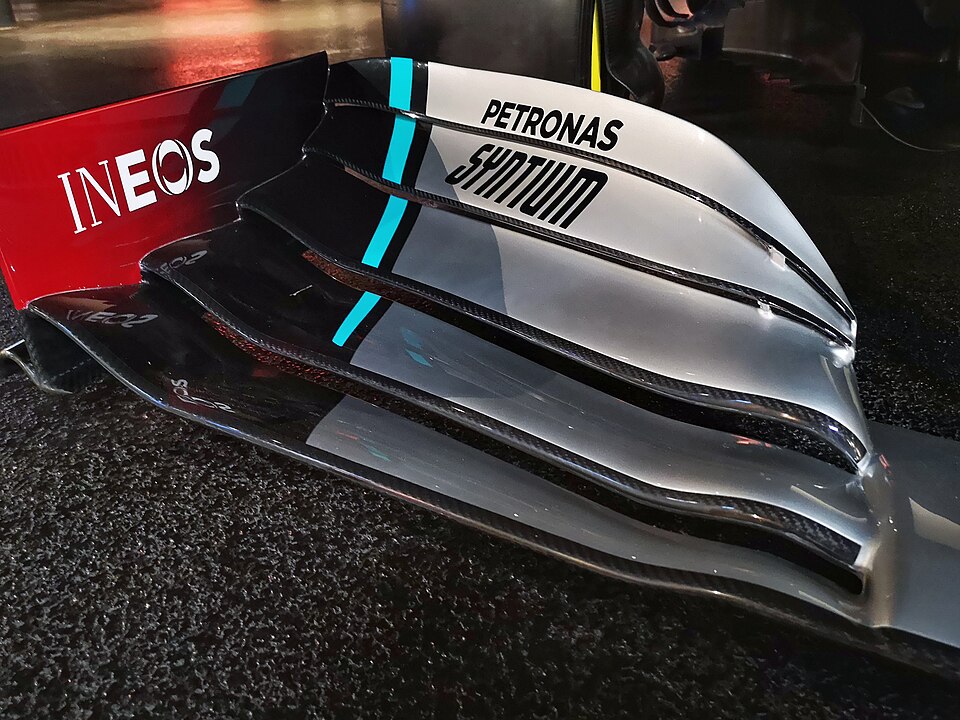
Aerodynamics is arguably the most complex and fastest-evolving aspect of racing physics. While weight transfer deals with the car’s mass, aerodynamics manipulates air to create forces that can far exceed the car’s own weight. The two primary aerodynamic goals are contradictory: create as much downforce as possible to increase grip, while minimizing drag that slows the car on straights.
This trade-off defines every aerodynamic decision, from wing angles to body shape. In recent years, Formula 1 has undergone a major shift back to ground-effect designs, revolutionizing how downforce is generated. The numbers are staggering: modern F1 cars produce downforce exceeding three times their own weight, a figure that seems impossible until you understand the underlying physics.
Record Downforce Levels: Over 3 Times Car Weight
In the 2024 and 2025 Formula 1 seasons, cars generate aerodynamic downforce that is over three times the vehicle’s weight at top speed (The Race, 2025). This means a 798 kg F1 car could theoretically drive upside down on a ceiling if it maintained sufficient speed, because the air pressing it down is stronger than gravity pulling it off. This level is a dramatic increase from just a few years ago, thanks to the 2022 regulation changes that reintroduced ground-effect tunnels.
Older F1 cars relied heavily on large front and rear wings, which created more drag. The current design philosophy uses the car’s entire shape and underbody to generate downforce more efficiently, though drag remains a significant limiting factor on long straights. This downforce allows cornering speeds that would have been unthinkable in the 1990s, with drivers sustaining lateral forces that test human endurance.
Ground Effect: Venturi Tunnels Create Massive Downforce
Ground effect is the primary downforce source in modern F1 cars. The principle uses venturi tunnels carved into the car’s underside. As air flows through these narrowing passages, its speed increases dramatically according to Bernoulli’s principle: faster moving air has lower pressure.
This creates a powerful suction that pulls the car toward the track surface. The Race (2025) notes that cars rely on venturi tunnels to generate massive downforce via ground effects. The tunnels are shaped like an inverted wing—narrow at the bottom, wide at the top—accelerating air and dropping pressure.
The result is a downforce that scales with the square of speed: double the speed yields four times the downforce. This is why ground-effect cars are unstable at low speeds (little downforce) but become incredibly fast through corners. The design also reduces drag compared to large wings, though it creates a critical vulnerability: if the ride height changes too much, airflow can separate and downforce can vanish or even reverse to lift.
Dirty Air: Downforce Retention Plummets to 65% in 2025
One of the biggest challenges in modern racing is “dirty air”—the turbulent wake left by a leading car that disrupts the following car’s aerodynamics. When a car follows another at close range, it loses a significant portion of its own downforce because the clean airflow is disturbed. The statistics show a troubling trend for racing quality:
- Downforce retention dropped from 85% in 2022 to 65% in 2025 when following at a distance of 10 meters (The Race, 2025).
- Downforce loss worsened from 15% to around 35% at the same following distance during the same period (The Race, 2025).
This means a chasing car in 2025 has only about two-thirds of the aerodynamic grip it would have in clean air. The impact on racing is severe: drivers struggle to follow closely, making overtakes extremely difficult. The car ahead can defend more easily because the follower’s tires and brakes overheat while battling the turbulent air.
This has been a major point of criticism for F1’s current regulations, despite the cars being faster in qualifying. The 2026 regulations promise a 30% reduction in overall downforce to address this issue, but the fundamental problem of dirty air remains a central challenge for series designers.
Performance Evolution: 2024 Cars 0.8 Seconds Faster Per Lap
The relentless development in aerodynamics and other areas has made cars significantly faster over recent seasons. In 2024, Formula 1 cars were roughly 0.8 seconds faster in qualifying per lap compared to 2023 (The Race, 2025). This improvement comes from teams extracting more downforce without proportionally increasing drag, better tire usage, and power unit gains.
However, 2025 is the final refined season before a major 30% downforce reduction is proposed for 2026 (The Race, 2025). This cut aims to make cars easier to follow and race wheel-to-wheel, even if it means slower lap times. The trade-off between pure performance and raceability is constant in motorsport.
Lap time improvements matter because they represent engineering progress and driver skill pushing the boundaries of what’s physically possible. But if the racing becomes processional, fans and stakeholders lose interest. The 2026 changes reflect a conscious decision to prioritize close racing over absolute speed.
G-Forces and Centripetal Force in Corners
When a car changes direction, it experiences centripetal acceleration—the force that pulls it toward the center of the corner. This acceleration is measured in G-forces, where 1G equals Earth’s gravity. In racing, lateral G-forces during cornering are the most physically demanding on drivers.
The physics formula is F = mv²/r: force equals mass times velocity squared divided by the corner radius. Higher speeds or tighter corners dramatically increase the force.
Modern F1 cars, with their immense downforce, can sustain cornering forces that would cause most people to black out. This places extraordinary physical demands on drivers, who must maintain precise control while their bodies are subjected to these extreme loads.
Cornering G-Forces: 4G to 6.5G in Modern F1
Centripetal force is what keeps a car moving in a curved path instead of going straight. In racing, this force is provided by the friction between the tires and the road. The magnitude of this force, expressed as G-force, determines how hard the driver is pressed against the seatbelts and how much the car’s tires can grip.
In 2024 and early 2025, drivers regularly experience between 4G and 6.5G in high-speed corners (Mercedes-AMG F1, 2024). To put this in perspective: a 70 kg driver feels a force equivalent to 280–455 kg pushing them sideways. The formula F = mv²/r shows that at constant speed, a smaller corner radius (tighter turn) increases G-force, while a larger radius allows higher speeds for the same G-load.
F1 circuits feature high-speed corners like Copse at Silverstone or the Esses at Suzuka that push these limits. Drivers train extensively to build neck and core strength to hold their heads steady against these forces, as even slight movements can impair vision and control.
Peak G-Force Corners: Suzuka, Silverstone, and Spa
Certain corners on the Formula 1 calendar are legendary for the extreme lateral forces they produce. These high-speed turns test the absolute limit of car and driver:
- Suzuka Circuit (Japan): Turn 1 and the famous 130R corner both exceed 5G lateral acceleration. The long, sweeping nature of these corners means drivers hold these forces for several seconds, demanding exceptional stamina (Mercedes-AMG F1, 2024).
- Silverstone Circuit (UK): Copse corner, a rapid right-hander taken at over 270 km/h, subjects drivers to approximately 5.5G. The high entry speed and minimal braking make it one of the most physically intense corners on the calendar (Mercedes-AMG F1, 2024).
- Spa-Francorchamps (Belgium): The Eau Rouge complex and the following Blanchimont corner are taken flat-out in modern F1, generating sustained lateral forces that can reach 5G+. The combination of elevation change and high speed makes these corners particularly demanding (Mercedes-AMG F1, 2024).
These corners require not only physical strength but also absolute confidence in the car’s aerodynamic grip. A slight mistake at these speeds and forces can have catastrophic consequences.
Physical Impact: Drivers’ Heads Feel Like 30 kg
The human body is not designed to withstand repeated exposure to 5G forces. The most affected area is the head and neck, which have a high mass relative to their support structure. A Formula 1 driver’s helmet and head assembly weighs about 7–8 kg.
Under a 5G lateral load, that weight multiplies to over 30 kg (Mercedes-AMG F1, 2024). For a 70 kg driver experiencing 5G, the total sideways force on their body is equivalent to 350 kg. This force acts on the neck muscles, which must contract isometrically to keep the head stable enough to see clearly.
Without intensive training, drivers would suffer whiplash, vision impairment, or loss of consciousness. Modern drivers follow rigorous neck-strength programs, using specialized harnesses and resistance training to build the necessary muscle endurance.
They also wear the HANS (Head and Neck Support) device, which anchors the helmet to the shoulders, reducing the effective weight of the head during impact. However, even with this equipment, the sustained G-forces over a race distance—often 300–400 km—cause extreme fatigue, making physical conditioning as critical as driving skill.
The most surprising insight is that modern Formula 1 cars generate downforce exceeding three times their own weight, enabling cornering speeds that seem physically impossible. This downforce, created through sophisticated ground-effect tunnels, transforms how cars interact with the track, making aerodynamics more critical than ever. For fans wanting to deepen their appreciation, one actionable step is to experience a high-fidelity racing simulator that accurately models weight transfer and G-forces, as described in how racing knowledge enhances fan experience.
You can explore world racing to see how these principles apply across different series, from karting to Formula 1. These simulators, available at many motorsport facilities, let you feel the physics firsthand. Alternatively, studying basic Newtonian mechanics—especially inertia, friction, and Bernoulli’s principle—provides a solid foundation for exploring international motorsports series.
You can explore world racing to see how these principles apply across different series, from karting to Formula 1. Understanding the physics turns every lap into a lesson in applied engineering.
