
Motorsport championships use varied points systems to reward consistency and race wins, with top finishers earning points that scale down. Formula 1 awards 25 points for a win, while MotoGP allows up to 37 points per weekend through combined sprint and race results.
These systems directly determine championship outcomes—as seen in Sarah Moore’s 2009 Ginetta Junior and 2018 Britcar Endurance titles—where consistent point-scoring separated champions from the field. Understanding these racing knowledge points systems across motorsport is essential for any fan or aspiring driver.
- Formula 1 awards 25 points for a win to the top 10 finishers, plus 1 for fastest lap; MotoGP allows up to 37 points per weekend through combined sprint and race results.
- Points systems balance rewarding race wins versus consistency—some series heavily favor top finishes, others reward finishing every race.
- Sarah Moore’s championships in Ginetta Junior and Britcar Endurance show how consistent point-scoring leads to titles across different series formats.
- Women’s racing series like W Series used F1-style scoring before financial issues ended the series in 2022; F1 Academy now continues as the premier all-female category.
Motorsport Points Systems Compared: F1, MotoGP, F3, and IMSA Scoring Explained
The landscape of motorsport features a diverse array of points allocation methods, each reflecting the unique characteristics and strategic priorities of the series. From the high-stakes, win-focused structure of Formula 1 to the weekend-dominance model of MotoGP, these systems shape how drivers and teams approach every session. Understanding the exact points breakdown for each championship reveals the underlying philosophy that governs title battles.
Formula 1’s 25-18-15 System: Top 10 Finishers and Fastest Lap Bonus
Formula 1 employs a points system that has become the benchmark for many other series. The core allocation for race finishes is:
- Positions 1–10: 25-18-15-12-10-8-6-4-2-1
- Fastest lap bonus: 1 point (awarded only if the driver finishes in the top 10)
- Sprint race points (when applicable): 8-7-6-5-4-3-2-1 for the top 8 finishers
Formula 1 employs a points system that has become the benchmark for many other series. The core allocation for race finishes is:
- Positions 1–10: 25-18-15-12-10-8-6-4-2-1
- Fastest lap bonus: 1 point (awarded only if the driver finishes in the top 10)
- Sprint race points (when applicable): 8-7-6-5-4-3-2-1 for the top 8 finishers
This structure rewards race wins heavily—a victory is worth more than two 10th-place finishes—while still providing meaningful points for drivers who finish just inside the points zone. The fastest lap bonus adds a tactical layer, encouraging drivers in the top 10 to push for an extra point even if they cannot improve their race position. The Formula 1 Sprint Race Format, introduced in 2021, offers additional points on select weekends, further increasing the maximum possible haul and creating more strategic variety across the season.
MotoGP’s Weekend Maximum: 37 Points Through Sprint and Race Combined
MotoGP operates on a weekend-based scoring model that combines two separate races:
- Sunday main race winner: 25 points
- Saturday sprint race winner: 12 points
- Points for lower positions in each race follow descending scales (top 15 in main race, top 9 in sprint)
- Maximum possible per weekend: 37 points (winning both races)
This system creates a different strategic emphasis than F1. Because a rider can score significant points in both the sprint and the main event, consistency across the entire weekend becomes crucial.
The sprint race, which debuted in 2023, rewards riders who can quickly adapt to track conditions on Saturday, while the main race remains the primary focus. The combined maximum means a dominant weekend yields nearly 50% more points than a single F1 race win, making each round a major points opportunity.
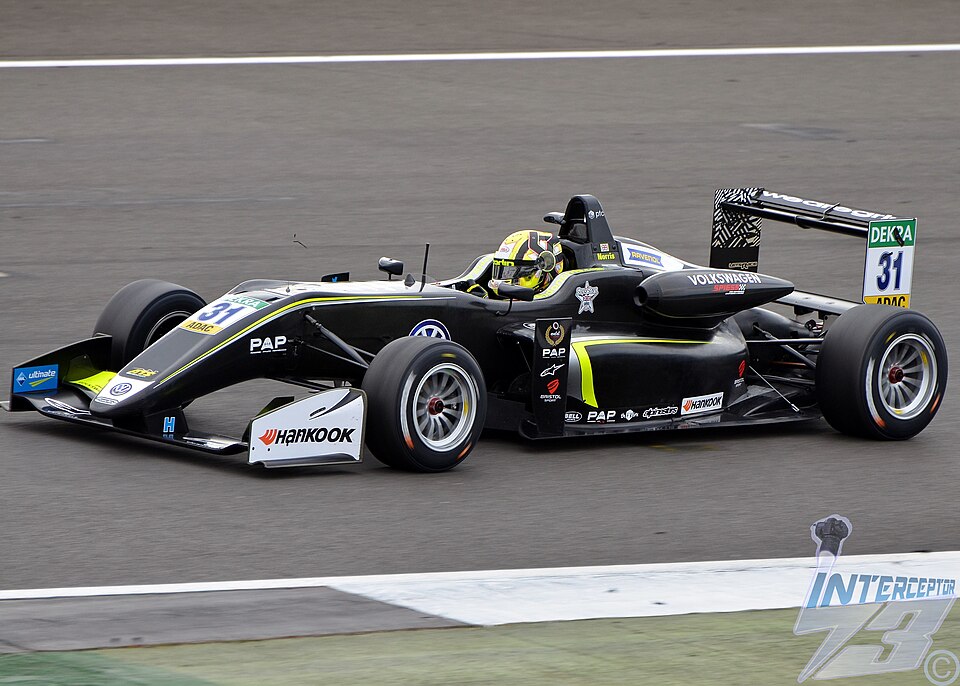
Formula 3’s Dual-Race Format: Feature vs Sprint Points Allocation
Formula 3 serves as a feeder series to Formula 2 and Formula 1, and its points system mirrors this developmental path. The series features two distinct race types per weekend:
- Feature race: Uses the same 25-18-15-12-10-8-6-4-2-1 scale as F1, awarding points to the top 10.
- Sprint race: Uses a reduced scale of 10-9-8-7-6-5-4-3-2-1 for the top 10 finishers.
The difference exists because the sprint race is shorter (typically around 20 minutes) and often determines the grid for the feature race. The lower points allocation reflects its secondary status, yet it still offers a substantial prize—10 points for a win—that can influence the championship. This structure tests drivers’ ability to perform under different race conditions and distances, preparing them for the step up to higher categories.
IMSA’s High-Points Approach: 350 for First Place and Endurance Considerations
The IMSA SportsCar Championship uses a dramatically scaled-up points system to accommodate its large, multi-class fields. As of 2021, the winner receives 350 points, with descending values for lower positions. This high-points model serves two purposes:
- It differentiates across fields that can exceed 50 cars in major endurance events.
- It reflects the longer race distances (e.g., 24 Hours of Daytona, 12 Hours of Sebring) where victory requires sustained performance and reliability.
| Series | 1st Place Points |
|---|---|
| Formula 1 | 25 |
| IMSA | 350 |
The sheer scale means that even a modest finish yields a considerable points haul, keeping more competitors in contention throughout the season. Points are awarded at each race toward the WeatherTech Championship, and the system applies across all classes (Prototype, GTD, etc.), allowing intra-class competition to remain intense despite the overall field size.
Consistency and Race Wins: How Points Systems Shape Championship Outcomes

Points systems are not arbitrary; they are carefully designed to balance the reward for race victories against the value of consistent, high finishes. This balance directly influences championship strategies, team decisions, and ultimately which drivers emerge as champions. Sarah Moore’s career provides concrete examples of how these systems play out in real-world title fights.
The General Principle: Points Systems Balance Consistency and Race Wins
All motorsport points systems aim to reward both consistent high finishes and race victories, but with different emphases. Some series, like Formula 1, heavily weight the win—25 points for first place versus just 1 point for 10th—making each race a high-stakes battle where a single victory can offset a couple of poor results. Others, such as those that award points to all finishers (e.g., NASCAR’s system where every starter gets points), encourage drivers to complete every race and avoid DNFs.
The design philosophy shapes season-long narratives: a series with a steep drop-off after the top positions favors aggressive winners, while a flatter curve rewards reliability and consistency. As the research notes, these varied systems “reward consistency and race wins” in different measures, creating distinct championship dynamics.
Sarah Moore’s 2009 Ginetta Junior Title: Consistency in a Mixed-Gender Series
At age 15, Sarah Moore won the 2009 Ginetta Junior Championship, becoming the first female champion in a TOCA-sanctioned mixed-gender series. The championship used an F1-style points structure (25-18-15… to 10th) that emphasized both race wins and podium consistency. Moore’s path to the title illustrates the principle:
- She scored points in nearly every race, minimizing zeros.
- Multiple race victories and podium finishes accumulated into a commanding points total.
- Her consistency overcame gender barriers and set a precedent for female drivers in junior formula racing.
This achievement demonstrates that in series with F1-like scoring, a driver does not need to win every race; rather, sustained high finishes across the season build an unassailable points advantage. Moore’s championship was a masterclass in strategic point accumulation.
2018 Britcar Endurance Championship: Endurance Racing’s Points Strategy
Endurance racing presents a different challenge: races last several hours, and finishing is itself a major accomplishment. The Britcar Endurance Championship, where Moore became the first female champion in 2018, employs points systems that reflect this reality. While the exact point scale may vary, endurance series typically:
- Award higher points for longer events (e.g., 24-hour races yield more points than 2-hour sprints).
- Emphasize reliability and consistency across multiple stints and driver changes.
- Reward teams that avoid mechanical failures and penalties.
Moore’s 2018 title showcased how consistent results across demanding endurance events build a championship points total. Unlike sprint series where a single win can skyrocket a driver, endurance championships often favor teams that finish every race strongly, making each points finish a valuable building block.
W Series and Championship Battles: How Points Systems Affect Female Drivers
The W Series adopted Formula 1’s standard points allocation (25 points for a win, descending to 1 point for 10th) for its races, creating a familiar framework for drivers and fans. Sarah Moore’s participation—finishing 8th in the 2019 championship with multiple race wins—highlights how the system operates in an all-female environment:
- Race wins provide a major points boost, but consistency across the season is equally vital.
- In close championships, every single point matters; a 10th-place finish versus a 9th can decide the runner-up position.
- The fastest lap bonus (if implemented) adds an extra strategic dimension, as an additional point can be decisive in a tight season.
The W Series points structure proved effective in generating dramatic season-long narratives, even as the series ultimately faced financial collapse. It demonstrated that a well-designed points system can create compelling racing, regardless of the gender composition of the grid.
Women’s Racing Series Points: W Series Scoring, Cancellation, and Future Prospects
The landscape of women’s single-seater racing has evolved rapidly, with points systems playing a key role in shaping competitive dynamics. The rise and fall of W Series, followed by the launch of F1 Academy, offers insights into how scoring formats integrate with broader series viability.
W Series Points Structure: How the All-Female Championship Was Scored
W Series used the exact 25-18-15-12-10-8-6-4-2-1 points system for its races, awarding points to the top 10 finishers. This created a straightforward championship standings system that fans could easily follow. The series did not include a fastest lap bonus, focusing purely on race results.
The points structure helped build dramatic season-long narratives as drivers accumulated totals across the calendar, with the championship often decided in the final rounds. The familiarity of the F1-style system also helped drivers transition to higher categories, as the scoring logic remained consistent.
Why the W Series Cancelled in 2022: Financial Issues and Points System Impact
The W Series ceased operations in October 2022 due to financial difficulties, making the Singapore round the final race. While the points system functioned effectively, the series’ business model could not secure sustainable funding, leaving drivers without a dedicated global female championship. This cancellation highlighted the challenges of maintaining a professional racing series outside the established motorsport ecosystem.
The points system itself was not a factor in the collapse; it was purely a financial issue. However, the abrupt end left many drivers, including Sarah Moore, seeking alternative pathways to continue their careers.
The Only Woman to Score F1 Points: Lella Lombardi’s Half-Point Milestone
Lella Lombardi remains the only female driver to score Formula 1 World Championship points. Her achievement:
- She earned 0.5 points for a 6th place finish at the 1975 Spanish Grand Prix.
- The race was shortened due to adverse conditions, resulting in half points being awarded under the regulations at the time.
- Under the full points system (9-6-4-3-2-1 for top 6), a 6th place would have earned 2 points, but the half-distance rule reduced it to 0.5.
- This half-point stands as a unique record in F1 history, underscoring the rarity of women competing at the highest level.
Lombardi’s milestone occurred under a completely different points structure, yet it remains the sole instance of a woman scoring in F1, highlighting the ongoing challenges for female drivers in reaching the pinnacle.
All-Female Racing Leagues Today: F1 Academy and the Points System Evolution
In 2023, F1 Academy launched as the new premier all-female single-seater series, running alongside select Formula 1 Grand Prix weekends. It employs a points system nearly identical to F1, awarding 25 points for a win and descending to 1 point for 10th, providing a familiar scoring framework for drivers aiming to progress to higher categories.
This alignment with F1 creates a clear development pathway and helps integrate female drivers into the broader motorsport landscape. The series has already produced competitive seasons and serves as a crucial stepping stone, with its points system designed to mirror the pinnacle and prepare drivers for future challenges in Formula 2, Formula 3, or beyond.
Points systems are not neutral—they actively shape racing strategies and championship narratives, sometimes favoring aggressive race winners over consistent finishers. For example, F1’s 25-point win reward creates high stakes for each race, while MotoGP’s 37-point weekend maximum encourages riders to maximize every session. Sarah Moore’s career demonstrates how understanding these systems is crucial for any driver aiming for a championship.
Now a driving instructor and coach, Moore exemplifies the practical application of this knowledge in developing future talent. To see this in action, follow the current F1 or F1 Academy seasons and track points after each race; official series websites provide live standings that reveal how every finish—and every fastest lap—affects the title fight. You can also learn more about her journey in professional racing.
The Formula 1 technical regulations that govern car performance, the hybrid power unit technology that defines modern F1, and Pirelli’s tire compound strategy all interact with points scoring, while the F1 budget cap influences team consistency. NASCAR’s pit stop strategies offer another perspective on how tactical elements impact points accumulation across different series.
Frequently Asked Questions About Racing Knowledge Points Systems Across Motorsport
Who is the only woman to earn a point in a grand prix race?
Lella Lombardi, one of the few women drivers to ever make it into F1. She also is the only female driver to gain points in F1. She placed 6th at the 1975 Spanish Grand Prix, earning points but due to it being a shortened race only got half a point.
Is Formula E losing popularity?
Those figures, which claimed a 491 million worldwide TV viewership, 23% growth in fans worldwide – up from a 304 million average in 2023, to 374 million last season, peaking at 386 million at start of the season – 20% growth in Formula E's social media following, and one billion impressions across a…
