
Pit stop efficiency in professional racing achieves sub-2.5-second tire changes in Formula 1 and sub-10-second full stops in NASCAR through choreographed teamwork and specialized roles. These milliseconds can determine race outcomes, making pit stop techniques a cornerstone of competitive strategy. This guide covers the procedures, crew training, and technology that enable such speed, including role specialization, simulation training, and AI-driven strategy optimization.
- F1 crews achieve ~2.5s tire changes through 20-person specialization and pneumatic wheel guns (reyrey.com, 2023).
- NASCAR full stops under 10s rely on coordinated jackmen, changers, and carriers with traffic light signals (Joe Gibbs Racing records).
- AI-driven pit window optimization and undercut strategies can gain 1-2s per lap (nhms.com, 2025; catapult.com).
How Do Racing Teams Achieve Sub-2.5-Second Pit Stops?
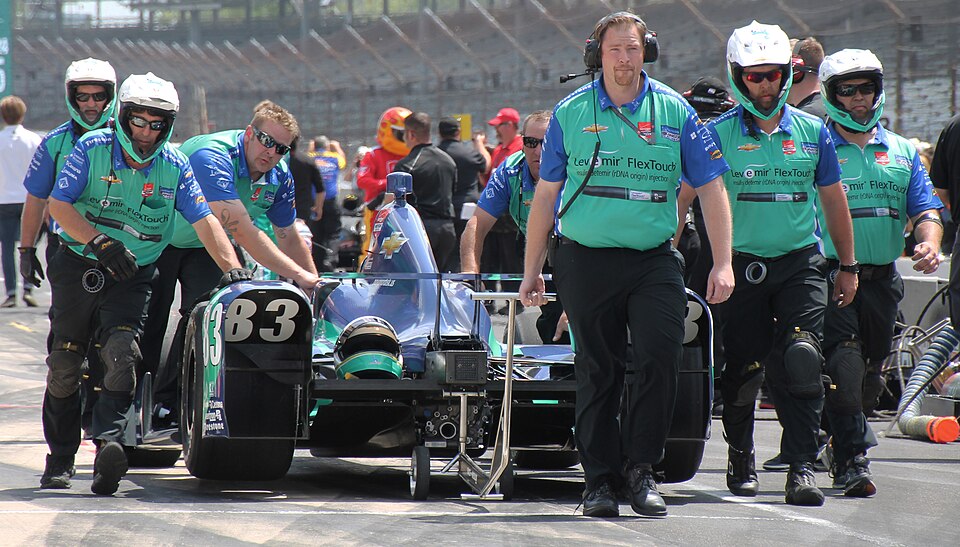
F1 vs. NASCAR: Time Benchmarks and Crew Size Differences
| Metric | F1 | NASCAR |
|---|---|---|
| Average tire change time | ~2.5 seconds (nhms.com, 2025; reyrey.com, 2023) | Included in full stop time; not separately reported |
| Total pit loss time | 18-25 seconds including pit lane (nhms.com, 2025; reyrey.com, 2023) | Under 10 seconds for full stop (Joe Gibbs Racing records, 2025-2026) |
| Typical crew size | 20 specialists (reyrey.com, 2023; v-hr.com, 2025) | Smaller crews, typically 5-7 members (based on role count) |
| Fastest recorded stop | Under 2 seconds (v-hr.com, 2025) | Under 10 seconds (Joe Gibbs Racing records, 2025-2026) |
| Key equipment differences | Pneumatic wheel guns, automatic jacks, no-fuel rules (post-2010) | High-strength manual tools, fueling included in some series |
Formula 1 achieves sub-2.5-second tire changes primarily through a larger crew that allows complete parallelism—each wheel has a dedicated gunner and carrier, while separate jackmen handle front and rear. The absence of refueling since 2010 eliminates a major time component.
NASCAR’s sub-10-second full stops include fueling and tire changes with fewer crew members, requiring each to multitask as part of NASCAR Pit Stop Strategies. The smaller crew size and inclusion of fueling make NASCAR stops inherently longer, but still remarkably fast through coordinated effort and traffic light signaling.
Specialized Roles: Wheel Gunners, Jackmen, and Tire Carriers
- Wheel Gunner: Operates pneumatic wheel gun to remove and install wheel nuts. Requires precise timing to avoid cross-threading. Positioned at each wheel arch during stop. (reyrey.com, 2023)
-
Jackman: Controls pneumatic jack to lift the car.
Must place jack accurately and raise/lower car smoothly. Often two jackmen for front and rear in F1. (v-hr.com, 2025)
-
Tire Carrier: Brings new tires from pit wall and removes old tires. Needs speed and agility to navigate around car.
Typically one per side in F1, with additional support in NASCAR. (Key Points)
- Support Roles: In F1, additional crew handle front wing adjustments, brake duct changes, and debris removal. NASCAR includes a fueler and a designated firefighter. (prev research)
Each role demands repetitive practice to build muscle memory. In F1, the 20-person crew ensures no overlap; in NASCAR, smaller crews mean some members perform multiple tasks, but still with clear primary responsibilities.
Driver Positioning and Traffic Light Signals: Precision Protocols
Drivers must stop their car within a narrow mark—often indicated by a painted box or sensor—to align perfectly with crew positions. Brake pressure is held constant to prevent car movement during the stop. In F1, a traffic light system (usually green when all work is complete) coordinates the driver’s exit; some teams use a “lollipop” sign.
These protocols eliminate hesitation: the driver does not release the brake until the green light, preventing premature acceleration that could endanger crew. The no-fuel rule in F1 post-2010 also simplifies procedures, as there is no need to coordinate fueling with other tasks. Every millisecond saved by precise positioning and clear signals contributes to the sub-2.5-second target.
Common Pit Stop Errors and Their Time Penalties
- Wheel Gun Slip: The pneumatic gun fails to engage the wheel nut on the first try, requiring a second attempt. This adds 1-3 seconds and often indicates poor nut alignment or gun calibration. (reddit.com/r/F1Technical)
- Misaligned Jack: The jackman places the jack slightly off-center, causing the car to sit unevenly. Crew then hesitate to work, adding 1-2 seconds while they adjust. (reddit.com/r/F1Technical)
-
Slow Tire Delivery: The tire carrier is delayed reaching the workstation, perhaps due to poor positioning or fumbling with tires.
This can add 1-2 seconds, especially if the car is ready to leave but waiting for a tire. (reddit.com/r/F1Technical)
- Communication Breakdown: In NASCAR, if the traffic light signal is misread or crew calls are unclear, the driver may wait unnecessarily, costing up to 2 seconds. (prev research)
These errors often compound: a wheel gun slip may force a redo, which then delays the jack release and ultimately the driver’s exit. Training focuses on eliminating such errors through repetition and simulation.
Crew Training: Fitness, Simulations, and Specialization
Physical Fitness Regimens for Pit Crew Athletes
Pit crew members undergo athletic training comparable to professional sports. Strength training focuses on explosive power for wheel gun strikes and jack lifts—exercises like power cleans and sled pushes build the necessary force. Endurance workouts (e.g., interval running, cycling) ensure crew can maintain peak performance across multiple stops in a race without fatigue degrading precision.
Reaction time drills, such as responding to light signals or auditory cues, sharpen the split-second timing needed for synchronized movements. Flexibility and mobility work prevent injuries during the high-intensity, awkward postures required during stops. Teams like Red Bull Racing employ dedicated strength and conditioning coaches to tailor programs to each role’s specific demands (v-hr.com, 2025).
Simulation Training: Recreating High-Pressure Scenarios
- Full Crew Drills: Teams practice complete pit stops with all members, using replica equipment and sometimes a stationary car. This builds muscle memory and coordination. Red Bull Racing uses a dedicated pit crew simulator that replicates the physical layout and timing of a real stop (v-hr.com, 2025).
- Pressure Simulations: Trainers introduce distractions—loud noises, time pressure, or deliberate equipment malfunctions—to teach crews to stay calm and adapt. This reduces error rates during actual high-stress race conditions.
-
Individual Role Repetition: Each member practices their specific task hundreds of times, focusing on perfecting the motion and reducing variability.
For example, a wheel gunner may practice on a wheel nut rig to achieve consistent engagement in under 0.5 seconds.
Simulation training allows teams to experiment with new techniques without race-day risk. Data from these sessions is analyzed to fine-tune procedures and identify bottlenecks.
Role Specialization: Why Each Crew Member Must Master One Task
Specialized Training—each member masters a single role—yields maximum speed and lowest error rates. In F1, a wheel gunner practices only that motion, achieving near-perfect reliability. The trade-off is reduced flexibility: if a specialist is unavailable, the team must substitute with a less experienced member, potentially slowing stops.
Cross-Training—where members learn multiple roles—increases roster flexibility, valuable in NASCAR where smaller crews may need to cover for each other. However, cross-trained members rarely match the speed of a dedicated specialist, as divided practice time prevents mastery.
Top F1 teams prioritize specialization; NASCAR teams often blend both, with a core of specialists and some cross-training for backup. The consensus from training experts is that specialization delivers the fastest stops, while cross-training provides resilience (Key Points).
Strategic Pit Stop Planning: Undercut, Overcut, and Data-Driven Decisions
Undercut vs. Overcut: When to Pit Early or Stay Out
Undercut: A driver pits earlier than a rival to gain fresh tires, hoping to set faster laps and leapfrog the competitor during their stop. This works best when tire degradation is high and the gap to the car ahead is small enough that the fresh-tire advantage outweighs the time lost in the pit lane.
Overcut: A driver stays out longer, maintaining track position while the rival pits. If the driver’s tires are still relatively fresh, they can push hard after their own eventual stop to minimize time loss. Overcut is riskier if tires suddenly degrade, causing loss of position before pitting.
Both strategies aim to gain 1-2 seconds per lap relative to the rival (catapult.com). Recent races show teams using undercuts on high-wear tracks like Monaco, while overcuts succeed on circuits with low tire degradation like Monza.
AI and Real-Time Data: Optimizing Pit Windows
Teams employ AI analytics platforms (e.g., Catapult, NHMS analytics) to process live data from tire sensors, lap timers, and weather forecasts. These systems simulate thousands of stint scenarios, predicting when tires will reach a critical degradation threshold and calculating the optimal lap to pit to maximize track position. Real-time tire wear data—including temperature, pressure, and grip loss—feeds into models that estimate the undercut potential.
For example, if data shows a competitor’s tires fading rapidly, the team may trigger an early pit to execute an undercut. This data-driven approach reduces guesswork and allows dynamic strategy adjustments during the race (nhms.com, May 2025).
Tire Wear Analysis and Stint Optimization
- Degradation Rate: The increase in lap time per lap as tires wear. Teams monitor this to predict when performance will drop below a threshold requiring a pit stop. (nhms.com, 2025)
- Lap Time Delta: The difference between the current lap time and the expected lap time on fresh tires. A growing delta signals increasing tire wear. (catapult.com)
-
Tire Temperature: Optimal operating range varies by compound, with Pirelli’s tire allocation strategy influencing available options (Formula 1 Tire Compound Strategy); overheating or underheating reduces grip.
[P26]
Sensors track temperature trends to anticipate performance loss. (reddit.com/r/F1Technical, 2024)
- Stint Length Planning: By combining degradation data with fuel load (where applicable), teams calculate the maximum possible stint length before pace drops critically. This informs the pit window and undercut/overcut decisions. (catapult.com)
These metrics are integrated into race strategy software, allowing crews to plan stops proactively rather than reactively. For instance, if degradation accelerates after 20 laps, the team may schedule a pit around lap 18 to avoid losing time later.
Sensors track temperature trends to anticipate performance loss. (reddit.com/r/F1Technical, 2024)
These metrics are integrated into race strategy software, allowing crews to plan stops proactively rather than reactively. For instance, if degradation accelerates after 20 laps, the team may schedule a pit around lap 18 to avoid losing time later.
The most surprising finding is that pit stop errors can cost 1-3 seconds, often more than the time saved by skipping training. A single wheel gun slip can negate the advantage of a perfectly executed undercut. To improve pit stop efficiency, implement simulation training twice weekly.
This builds the muscle memory and team coordination needed to consistently achieve sub-2.5-second stops in F1 or sub-10-second stops in NASCAR. For more on professional racing techniques, visit Sarah Moore Racing.
