Racecraft overtaking defense is the combined skill of protecting your track position and executing successful passes. Sarah Moore, a champion driver with 18 years of competition experience and 25 years in racing, defines it as anticipating opponents, using proactive positioning, and maintaining optimal corner exits for defense, while attacking means forcing rivals into longer lines. Her coaching highlights that mental strength underpins both, enabling drivers to perform under pressure in professional racing environments.
- Proactive defensive positioning—picking your line early—prevents collisions and maintains control (Sarah Moore’s coaching principle).
- Corner exit speed is critical: high-speed exits make overtakes harder on following straights (technique emphasized by Moore).
- Attacking success depends on setting up passes in the corner before the overtaking zone (key racecraft insight from Moore’s experience).
Defensive Racecraft: Proactive Positioning and Corner Exit Mastery

Defensive Technique Comparison: Data Overview
| Technique | Key Principle | Implementation | Benefit |
|---|---|---|---|
| Proactive Line Selection | Predictability | Pick line early, commit to it | Avoids collisions, maintains control |
| Corner Exit Optimization | High-speed exits | Focus on apex control, throttle application | Harder to overtake on following straights |
| Outside Line Forcing | Position to force attacker outside | Place car to take inside line, attacker must go outside | Attacker takes longer route, loses time |
| Situational Awareness | Monitor competitors | Constantly check mirrors, anticipate overtake spots | Prevents surprises, allows proactive defense |
These four techniques form an interconnected system essential for effective defense. Proactive line selection relies on situational awareness to choose the correct line based on track conditions and competitor behavior. Corner exit optimization supports outside line forcing by ensuring you have the speed to position your car decisively.
Without awareness, line selection becomes reactive; without exit optimization, positioning loses impact; without forcing outside lines, defenders remain passive. Sarah Moore’s coaching stresses integrating all four to create a holistic, collision-avoidant defense that is difficult to penetrate.
Proactive Line Selection: The Foundation of Defense
- Why picking a line early is better than reacting: Committing to a line early makes your driving predictable, reducing sudden movements that cause collisions. Reacting aggressively often leads to last-minute adjustments that endanger both cars.
-
How to choose the optimal line based on track conditions: Consider track temperature, tire wear, and grip levels.
In dry conditions, a classic outside-inside-outside trajectory may be fastest. In wet conditions, a more conservative line with higher grip might be necessary. Adjust based on your car’s handling and competitor strengths.
-
How this reduces collision risk: By signaling your intentions early, you give opponents clear information to adjust smoothly. This prevents chaotic last-moment evasions and maintains race flow.
Defending proactively by picking a line early helps avoid collisions, a core principle in Moore’s coaching.
Corner Exit Mastery: Making Overtakes Harder
- The relationship between corner exit speed and straight-line speed: Higher exit velocity translates directly to faster acceleration on the subsequent straight. Even a small speed advantage at corner exit can grow into a significant gap before the next braking zone.
-
Techniques to maximize exit speed: Control the apex precisely to shorten the corner radius, apply throttle smoothly and early to manage wheelspin, and maintain track position to avoid losing momentum.
Focus on getting high-speed exits, making it harder for competitors to overtake on the following straight.
-
Why a fast exit deters overtakes: A car with a speed advantage on the straight can often defend against inside moves because the attacker cannot close the gap before the braking point.
This forces the attacker to attempt riskier, longer-range passes.
Attacking Racecraft: Setting Up and Executing Overtakes
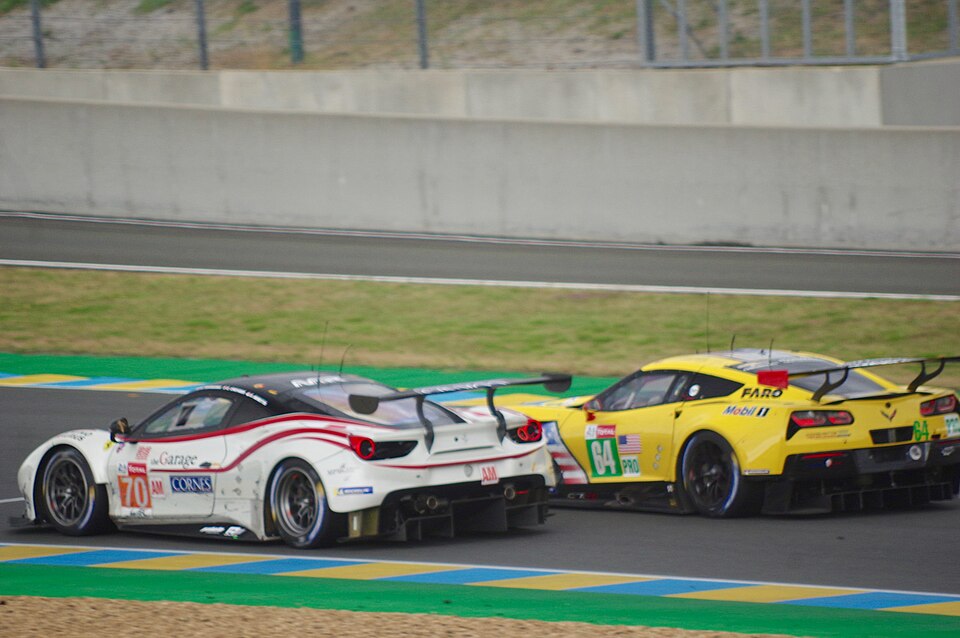
The Corner-Before Setup: Creating Overtake Opportunities
- Identify a slower corner where you can gain an advantage: Look for corners where the defender might be weak, such as a tight hairpin, a corner with poor exit visibility, or one where they have historically struggled. The overtake actually happens on the corner before the intended overtaking spot, ensuring a better exit speed.
- Optimize your exit to carry more speed onto the straight: Use a late apex or a different line to maximize acceleration onto the straight. This might involve sacrificing a little corner entry speed for a much faster exit.
- Use the slipstream to close the gap: Tuck into the defender’s aerodynamic wake to reduce drag and gain speed. This is particularly effective on long straights where the slipstream effect is strongest.
- Execute the pass at the braking zone: With the speed advantage from the slipstream and better exit, dive down the inside at the braking point. Ensure you are significantly alongside before turn-in to avoid being forced wide or causing a collision.
Advanced Tactics: Dummy Moves and Late Braking
- Dummy moves: Feint to one side to make the defender cover, then take the other line. This exploits the defender’s reaction, creating an opening on the opposite side. Use when the defender is predictable and has a tendency to mirror your movements. The risk is that if the feint is too obvious, it may waste time and allow other competitors to close in.
- Late braking: Utilize superior slipstream or braking control to dive down the inside, ensuring you are significantly alongside before turn-in. This requires precise timing and confidence in your braking ability. The risk includes lock-ups, going off-track, or if you are not fully alongside, being deemed at fault in a collision.
Racecraft Development: Coaching, Mental Strength, and Breaking Barriers
Mental Strength: Overcoming Barriers in High-Pressure Racing
Sarah Moore emphasizes that the biggest hurdle in racecraft is often mental. Drivers must ignore negative comments and focus entirely on performance. Her own journey breaking gender barriers and being an openly LGBTQ+ driver in a male-dominated sport required immense mental resilience.
This resilience directly translates to better decision-making on track, where panic or doubt can lead to errors. Mental strength allows drivers to stay calm under pressure, execute techniques consistently, and bounce back from setbacks—key aspects of both defense and attack. For effective defending, Moore notes that mental focus prevents overreaction and maintains strategic clarity.
Coaching the Next Generation at More Than Equal
As a driver coach with More Than Equal, Sarah Moore leverages her 25 years of racing experience and 18 years of competition to develop young female racers. The program focuses on technical skills and mental fortitude, addressing unique challenges women face in motorsport. Moore’s historic achievements—becoming the first female to win the Ginetta Junior Championship in 2009 and the Britcar Endurance Championship in 2018—provide a foundation for her coaching.
She helps drivers build confidence, strategic thinking, and the resilience needed to compete at high levels. Currently, as a driver coach, she helps young female racers develop technical and mental skills, passing on lessons from her own career in the W Series and beyond.
LGBTQ+ Representation and Advocacy in Motorsport
Moore’s impact extends to LGBTQ+ advocacy. In 2021, she became the first openly LGBTQ+ driver to stand on a podium during an F1 Grand Prix weekend at the W Series Austria round. As a Racing Pride ambassador, she promotes LGBTQ+ inclusion in motorsports.
Her feature in the National Motor Museum exhibition highlights her role in advancing representation. Representation matters because it inspires others and challenges stereotypes, fostering a more inclusive environment where talent thrives regardless of identity. This advocacy ties into her broader mission of breaking barriers and empowering drivers, showing that racecraft excellence is accessible to all who dedicate themselves to the sport.
The most surprising insight is that racecraft is as much a mental game as a physical one. Sarah Moore’s success stems from her ability to anticipate opponents and maintain mental strength under pressure. Her techniques—proactive defense, corner exit mastery, and strategic attacking—all rely on sharp focus and resilience.
To apply this, practice picking your defensive line early on your next track day. Observe how this proactive approach improves your corner exits and reduces overtaking vulnerability.
By strengthening your mental game, you’ll make better decisions and consistently outmaneuver competitors. For more on professional racing techniques, explore professional racing strategies.
