
Race car aerodynamics centers on balancing two opposing forces: downforce, which presses the car to the track, and drag, which resists its motion through air. Together these forces dictate 30-50% of lap time, making aerodynamic optimization the single most critical engineering challenge in motorsports. Understanding this balance explains why Formula 1 cars corner at 5-6G while NASCAR drafters gain 5mph on superspeedways—and why the 2026 F1 regulations mandate a 20-25% downforce reduction.
Aerodynamic design varies dramatically across racing disciplines, from the intricate wing complexes of F1 to the bumper-to-bumper packs of NASCAR. In 2025-2026, the FIA’s upcoming rule changes will reshape car architecture, emphasizing cleaner airflow and reduced turbulent wake.
- Downforce presses the car to the track, increasing grip; F1 cars generate >3x their weight in downforce (borntoengineer.com, 2025).
- Drag slows the car; drafting can reduce drag by 20-30% and gain 5mph (Wikipedia, 2024).
- Aerodynamic balance is track-specific: Monaco uses high downforce, Monza uses low drag (Key Points).
- 2026 F1 regulations will cut downforce by 20-25%, shifting the design paradigm (nytimes.com, 2025).
How Do Downforce and Drag Interact in Race Car Aerodynamics?
Defining Downforce: F1 Cars Generate 3.5x Their Weight in Grip
- Downforce magnitude: Formula 1 cars produce downforce exceeding 3 times their vehicle weight (~3,500 lbs) at racing speeds (borntoengineer.com, 2025).
- Generation mechanisms: Inverted wings create downward lift; diffusers accelerate air under the car; ground-effect floors use Venturi tunnels to create suction (Key Points).
- Cornering impact: This downforce enables lateral forces of 5-6G, allowing cars to maintain speeds through corners that would otherwise cause complete loss of traction (Key Points).
The physics behind downforce mirrors aviation lift but reversed. Inverted wings, diffusers, and ground-effect floors all work to increase pressure on the car’s upper surfaces while lowering pressure underneath. This ‘aerodynamic grip’ supplements mechanical tire grip, allowing cornering forces that would be impossible otherwise.
Downforce increases with the square of speed—doubling speed quadruples the force—making it a critical factor at high-speed circuits. For example, an F1 car generating 3,500 lbs of downforce at 150 mph would produce nearly 14,000 lbs at 300 mph, though such speeds are not reached on most tracks.
The 5-6G cornering forces enable lap times that defy intuition. At Monaco, cars navigate the Fairmont Hairpin at just 30 mph but still carry significant downforce to accelerate out.
Conversely, at Monza, downforce is reduced to minimize drag on the 1.1 km straights, yet the cars still pull 3-4G through the Parabolica. This demonstrates how downforce must be balanced against drag for each circuit’s unique demands.
Defining Drag: Slipstreaming Cuts Air Resistance by 20-30%
- Drag definition: Drag (air resistance) acts opposite to motion, reducing straight-line speed and acceleration (Key Points).
- Drafting effect: Following another car within 1-2 car lengths reduces trailing vehicle drag by 20-30% (Wikipedia, 2024).
- Speed gain: This drag reduction translates to approximately 5mph advantage on straights (SimScale/Wikipedia, 2024).
Drag originates from three sources: pressure drag (form drag) from air displacement, skin friction from surface contact, and induced drag as a byproduct of downforce generation. At racing speeds, drag force increases with velocity squared, making it a dominant factor on long straights.
A typical Formula 1 car has a drag coefficient (Cd) between 0.7 and 0.9, but with ground-effect designs, Cd can be as low as 0.5 while still generating significant downforce. Drag consumes a large portion of engine power—at 200 mph, overcoming air resistance can require over 50% of the power unit’s output.
The drafting phenomenon occurs when a trailing car enters the low-pressure wake of a leader, reducing air resistance dramatically. This 20-30% reduction explains why NASCAR pack racing produces such close competition—and why overtaking often requires strategic slingshot maneuvers using this aerodynamic advantage.
However, drafting also reduces the trailing car’s downforce because the turbulent air is less dense, which can compromise cornering grip. Drivers must therefore balance the straight-line speed benefit against potential handling degradation when following closely.
The Inherent Trade-Off: More Downforce Always Increases Drag
The fundamental law of race car aerodynamics states: downforce inherently increases drag. Every wing, diffuser, or venturi tunnel that presses the car to the track also disrupts airflow, creating resistance. This trade-off defines the engineer’s eternal dilemma: how to maximize grip without sacrificing straight-line speed.
The efficiency of an aerodynamic element is expressed by its lift-to-drag ratio (L/D). A typical F1 rear wing might have an L/D of 4:1—meaning it generates 4 units of downforce for every 1 unit of drag. Ground-effect floors can achieve L/D ratios of 10:1 or higher, making them more efficient.
However, even the most efficient downforce-generating surfaces add some drag. The relationship is not linear; small adjustments can cause disproportionate effects. For instance, increasing rear wing angle by 2° might add 50 lbs of downforce but also increase drag by 30%, due to flow separation.
This sensitivity is why teams invest heavily in CFD and wind tunnel time to map the ‘drag bucket’—the optimal range where downforce is maximized for minimal drag penalty. Active aerodynamics, such as DRS, attempt to decouple this trade-off by allowing drivers to reduce drag on straights, but regulations limit their use to maintain racing integrity.
Quantifying the Impact: Aerodynamics Dictates 30-50% of Lap Time
- Lap time influence: Aerodynamic efficiency accounts for 30-50% of total lap time variation between competitive cars (Key Points).
- Handling consequences: Poor aero balance—where front and rear downforce distribution mismatches suspension setup—causes understeer (front slides wide) or oversteer (rear slides out) (Key Points).
- Data volume: Modern F1 teams process 1.1 million data points per second from sensors monitoring airflow, pressure, and vehicle dynamics (borntoengineer.com, 2025).
This 30-50% figure quantifies why aerodynamics dominates F1 budgets and research. A 1% aerodynamic improvement can translate to 0.1-0.3 seconds per lap—often enough to secure pole position or gain multiple positions during a race. The impact varies by circuit; at high-speed tracks like Monza, aerodynamics may account for nearly 50% of lap time, while at low-speed tight circuits like Monaco, mechanical grip plays a larger role but aero still contributes significantly through cornering stability.
The data deluge (1.1 million points/sec) comes from approximately 300 sensors per car: pressure taps on wings and floor, accelerometers, gyroscopes, and temperature probes. This real-time telemetry allows engineers to monitor aerodynamic performance and make immediate adjustments. Handling issues directly trace to aero balance: too much front downforce relative to rear causes understeer; too much rear downforce causes oversteer.
Adjusting wing angles, ride height, or bodywork shifts this balance, requiring drivers to adapt their steering input. This sensitivity makes aerodynamic setup arguably more impactful than engine power in modern racing.
Teams also use historical data to predict how aero performance will evolve as fuel burns off and tires wear, fine-tuning setups for race conditions. The extensive data collection infrastructure represents a significant investment, contributing to the sport’s overall cost pressures that led to the introduction of a budget cap (Formula 1 budget cap).
Track-Specific Aero Strategies: High Downforce vs Low Drag Setups
Monaco vs Monza: Opposite Ends of the Aero Spectrum
| Setup Parameter | Monaco (High Downforce) | Monza (Low Drag) |
|---|---|---|
| Wing angle | Maximum rear wing deflection (8-12°) | Minimal rear wing (1-3°) |
| Front wing | Complex multi-element design | Simplified single-element |
| Ride height | Higher to manage ground effect | Lower to reduce drag |
| Primary goal | Cornering grip through slow turns | Top speed on 1.1km straights |
| Downforce level | ~2,500-2,800 lbs | ~1,200-1,500 lbs |
These two iconic circuits represent aerodynamic opposites. Monaco’s 19 turns, many under 60 mph, require maximum mechanical grip. Teams install the largest possible wings and aggressive diffusers, sacrificing 15-20mph top speed for cornering stability.
At Monaco, the circuit’s tight layout and low-speed corners demand maximum downforce to keep the cars glued to the narrow streets. Teams typically run a rear wing with a 12-15° angle, compared to the 5-7° used at Monza.
The front wing features multiple elements to generate additional front-end grip. This high-downforce setup reduces top speed by an estimated 15-20 mph on the straights, but the trade-off is essential for maintaining momentum through the corners.
Monza’s 11km of straights and only 11 corners demands minimal drag: teams run ‘low-drag’ packages with tiny wings and streamlined bodywork, accepting understeer in exchange for 15-20mph higher terminal velocity. The same F1 car must reconfigure dramatically between these races—a testament to aerodynamics’ track-specific nature. In contrast, Monza’s long straights and high-speed corners like the Parabolica require minimizing drag.
Teams use a ‘low-drag’ rear wing with just 1-3° angle and a simplified front wing. The reduced downforce can cause understeer in the slower chicanes, so drivers must carefully manage their entry speeds. The difference in aerodynamic configuration between these two races is perhaps the most extreme on the F1 calendar, highlighting the need for versatile car designs.
Oval Racing: NASCAR’s Drafting Strategy Gains 5mph
- Drafting mechanics: On superspeedways like Daytona and Talladega, cars run bumper-to-bumper at 200+mph, using slipstream to reduce drag by 20-30% (Data & Stats).
- Speed advantage: This drag reduction provides approximately 5mph speed gain, enough to overtake on long straights (Data & Stats).
- 2024 evolution: Side drafting—where a car pulls alongside another to disrupt its airflow—became a key overtaking tactic in 2024 NASCAR Cup Series (Data & Stats).
Oval racing transforms aerodynamics from individual performance to pack dynamics. At superspeedways like Daytona and Talladega, cars reach speeds over 200 mph. The air at these velocities behaves like a viscous fluid; when a car follows another within 1-2 car lengths, it enters the low-pressure wake, reducing drag by 20-30%.
This drag reduction translates to a 5 mph speed advantage, which is enough to facilitate overtaking on the long straights. The effect compounds: as more cars join the draft, the entire pack accelerates, creating multi-car trains where everyone benefits. However, drafting also reduces the trailing car’s downforce because the turbulent air is less dense, leading to handling challenges—drivers often report a ‘loose’ feeling when following closely.
NASCAR’s use of tapered spacers (replacing restrictor plates) limits engine power, making aerodynamic efficiency even more critical. The 2024 season saw strategic side drafting emerge as a key tactic: a car pulls alongside another to disrupt its airflow, causing the opponent to lose downforce and allowing the drafter to slingshot past.
This collective aerodynamic behavior makes superspeedway racing uniquely unpredictable compared to road courses where individual car setup dominates. This pack dynamics directly influence pit stop strategies, as teams must plan for the likelihood of drafting on restarts (NASCAR pit stop strategies).
Aero Balance and Handling: Understeer vs Oversteer
Aerodynamic balance—the ratio of front-to-rear downforce—directly determines handling characteristics. Front-heavy aero balance (more downforce at the front axle) causes understeer: the front tires lose grip before the rear, pushing the car wide in corners. Rear-heavy balance causes oversteer: rear tires break loose first, spinning the car.
This balance is not static; because downforce increases with the square of speed, a car perfectly balanced at 100 mph may understeer severely at 180 mph as rear downforce grows disproportionately. Teams adjust this balance via front and rear wing angles, diffuser exits, and underbody tunnel shapes. Wind tunnel testing maps the front-to-rear downforce distribution across various ride heights and speeds.
Driver feedback is crucial: a driver may prefer a slight understeer for predictability, while others thrive on oversteer for rotation. The interaction with mechanical setup (springs, anti-roll bars) adds complexity—changing one affects the other.
For example, in 2023, Red Bull’s RB19 featured a rear-biased aero balance that excelled in high-speed corners but required careful tire management to avoid oversteer on worn tires. Such nuances make aerodynamic setup a continuous fine-tuning process throughout a race weekend.
IndyCar Oval Trims: Reducing Drag for Superspeedways
- Superspeedway configuration: For Indianapolis and Texas ovals, IndyCar teams remove front wing elements entirely, running nearly flat undertrays and minimal rear wings (Key Points).
- Drag reduction: These “low-drag superspeedway trims” cut drag coefficient by approximately 15-20% compared to road course setups (Key Points).
- Speed targets: At Indianapolis Motor Speedway, these setups enable 230+mph average speeds on the 2.5-mile oval (Key Points).
IndyCar’s dual-discipline nature—competing on both ovals and road/street circuits—requires radical aerodynamic reconfiguration between events. The standard road course package features a complex multi-element front wing and a large rear wing, generating substantial downforce for cornering. For superspeedways like Indianapolis and Texas, teams install a ‘speedway kit’ that transforms the car into a low-drag missile.
The front wing is replaced by a simple endplate with a minimal flap, and the underbody tunnels are sealed to smooth airflow and reduce drag. These changes cut the drag coefficient by approximately 15-20% compared to the road course setup. At Indianapolis Motor Speedway, such configurations enable average speeds exceeding 230 mph on the 2.5-mile oval.
Unlike NASCAR’s pack-drafting emphasis, IndyCar’s higher power-to-weight ratios and lower absolute downforce levels mean that individual car speed is paramount; drafting still occurs but is less critical. The switch between setups is a meticulous process: teams must also adjust suspension geometry, brake bias, and gear ratios to accommodate the altered aerodynamic characteristics. This versatility showcases the engineering adaptability required in modern open-wheel racing.
What Does the Future Hold for Race Car Aerodynamics?
Ground Effect: Venturi Floors Create Suction for Massive Downforce
- Principle: Ground effect uses Venturi tunnels—narrow passages under the car—to accelerate airflow, creating low pressure that “sucks” the vehicle to the track (Entities).
- 2025 F1 implementation: Current Formula 1 cars feature aggressive underbody tunnels and diffusers generating massive downforce without large wings (Key Points).
- Efficiency: Ground-effect downforce is more aerodynamically efficient than wings, producing less drag per unit of downforce (Entities).
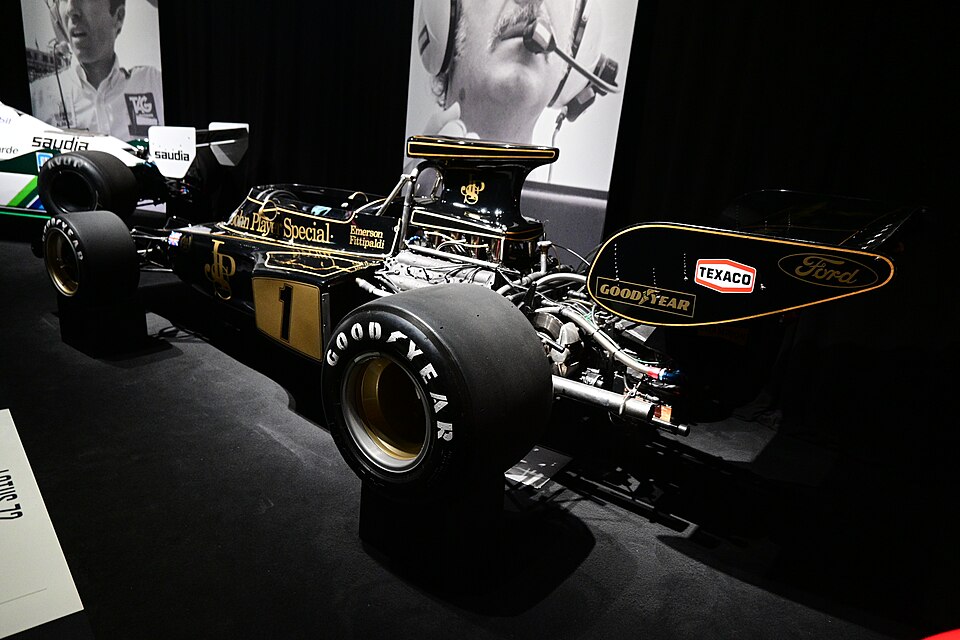
Ground effect represents the most significant aerodynamic innovation since the introduction of wings. The principle, pioneered by Lotus in the 1970s, uses Venturi tunnels—narrow passages under the car—to accelerate airflow, creating a low-pressure zone that ‘sucks’ the vehicle to the track. This downforce is more aerodynamically efficient than wings because it generates less drag per unit of downforce.
The 2022 Formula 1 regulations reintroduced ground-effect tunnels after a decades-long ban, fundamentally reshaping car design. Modern F1 cars feature aggressive underbody tunnels and diffusers that produce massive downforce without large external wings. However, ground effect is highly sensitive to ride height and track surface irregularities; a bump can disrupt the airflow, causing sudden downforce loss—a phenomenon known as ‘porpoising’ that plagued the 2022 season.
Teams now use sophisticated suspension systems to maintain optimal ride height and manage the delicate balance between downforce and drag. The technology has also influenced other series: IndyCar’s Dallara IR18 chassis incorporates ground-effect elements, and Le Mans prototypes rely heavily on underbody aerodynamics. As regulations evolve, ground effect remains central to achieving high aerodynamic efficiency.
2026 Regulations: FIA Mandates 20-25% Downforce Reduction
- Regulation change: The 2026 FIA technical regulations require a 20-25% reduction in total downforce compared to 2025 baselines (nytimes.com, 2025).
- Rationale: This aims to reduce ‘dirty air’—turbulent wake from leading cars that makes following and overtaking difficult (Key Points).
- Transition: The downforce cut precedes the introduction of active aerodynamics in 2027-2028, representing a major design shift (Key Points).
The 2026 FIA technical regulations mandate a 20-25% reduction in total downforce compared to 2025 baselines, marking the most radical aerodynamic change since the 2022 ground-effect reintroduction. The primary goal is to reduce ‘dirty air’—the turbulent wake left by leading cars that disrupts following vehicles, making close racing and overtaking extremely difficult. By cutting downforce, cars will produce less wake, allowing rivals to get closer without losing aerodynamic stability.
This shift precedes the planned introduction of active aerodynamics (adjustable wings and flaps) in 2027-2028, which will further enhance racing quality. Teams face a formidable engineering challenge: achieve the downforce reduction while preserving cornering speeds and overall lap times. Early 2025 development has focused on ‘cleaner’ aerodynamic designs that generate less turbulent wake, such as refining floor edge vortices and simplifying front wing architectures.
The regulations also mandate larger wheel arches and a simplified front wing to further minimize aerodynamic disturbance. With wind tunnel and CFD time strictly limited by the budget cap, teams must prioritize efficiency, turning the 2025 season into a de facto testing ground for 2026 concepts.
This reset forces a complete rethink of car philosophy, potentially closing the performance gap between midfield and top teams. For a detailed breakdown of the upcoming changes, see the Formula 1 technical regulations 2026.
Data-Driven Tuning: F1 Collects 1.1 Million Data Points Per Second
Modern Formula 1 cars are flying laboratories, equipped with approximately 300 sensors that measure pressure, temperature, velocity, and strain at critical aerodynamic points. At racing speed, these sensors stream 1.1 million data points per second to engineers in the garage and back at the team’s factory. This real-time telemetry includes pressure readings from taps on the front wing, rear wing, and floor; accelerometer data from the suspension and chassis; and airflow velocity from pitot tubes.
Engineers use this flood of information to validate computational fluid dynamics (CFD) models, detect airflow separation, and fine-tune wing angles and ride height. For example, if pressure sensors indicate a loss of front-wing downforce, the team can instruct the driver to adjust the front wing flap via the steering wheel. The data also tracks how aerodynamic performance evolves as fuel burns off and tires wear, allowing teams to predict optimal setup changes for race conditions.
Advanced machine learning algorithms sift through the historical data to identify patterns and recommend setup adjustments, turning raw numbers into competitive advantage. This data-driven approach has become essential in an era where aerodynamic gains of 0.1 seconds per lap can determine podium positions. The cost of such data infrastructure is a factor in the sport’s budget cap constraints (Formula 1 budget cap).
Machine Learning Breakthrough: 43% Drag Cut with +7% Downforce
| Metric | Traditional Design | ML-Optimized Design | Improvement |
|---|---|---|---|
| Drag coefficient (Cd) | 0.85 | 0.48 | -43% |
| Downforce (lbs at 200mph) | 1,250 | 1,338 | +7% |
| Lift-to-drag ratio | 1.47 | 2.79 | +90% |
| Optimal wing angle (°) | 12.5° | 10.2° | -2.3° |
A 2023 study from the University of Cambridge’s Department of Engineering demonstrated machine learning’s potential to break traditional aerodynamic trade-offs. Researchers employed genetic algorithms to explore thousands of rear wing designs, using a fitness function that simultaneously minimized drag and maximized downforce. The resulting ML-optimized wing achieved a 43% reduction in drag coefficient (from 0.85 to 0.48) while increasing downforce by 7% (from 1,250 to 1,338 lbs at 200 mph).
This combination—lower drag and higher downforce—was long considered unattainable because conventional wisdom held that increasing downforce always came at the cost of increased drag. The ML-generated wing featured unconventional surface curves, a wavy leading edge, and serrated trailing edges that manipulated airflow in ways human designers might not intuit. While Formula 1 teams already use machine learning for CFD mesh optimization and setup predictions, this study suggests the next frontier: AI-generated aerodynamic surfaces that could fundamentally reshape car design.
However, regulatory constraints (spec parts, dimensional limits) and the need for extensive physical validation mean such radical designs may take years to appear on track. Nonetheless, the study proves that the traditional downforce-drag coupling can be broken, opening new avenues for efficiency gains. Machine learning is also transforming power unit development, as seen in the 2026 hybrid systems (Formula 1 power unit technology 2026).
The balance between downforce and drag remains motorsports’ central aerodynamic challenge. With aerodynamics governing 30-50% of lap time, even marginal gains translate to significant competitive advantages. The 2026 F1 downforce reduction will force teams to rethink ground-effect efficiency, while machine learning promises to reshape design paradigms.
For tracks like Monaco versus Monza, the optimal balance differs dramatically—proving that race car aerodynamics is never about maximizing either force, but about finding the precise point where they complement each other for that specific circuit, that specific speed, that specific moment. Most surprising finding: Aerodynamics can account for up to half of a lap’s time, making it the single most important performance factor.
Action step: Study your local track’s characteristics to understand whether a high-downforce or low-drag setup would be optimal—use the Monaco vs Monza example as a guide. For more detailed analysis of professional racing strategies, visit professional racing resources.
