
Safety Car Procedures 2026: Rules, Systems, and Strategic Impact
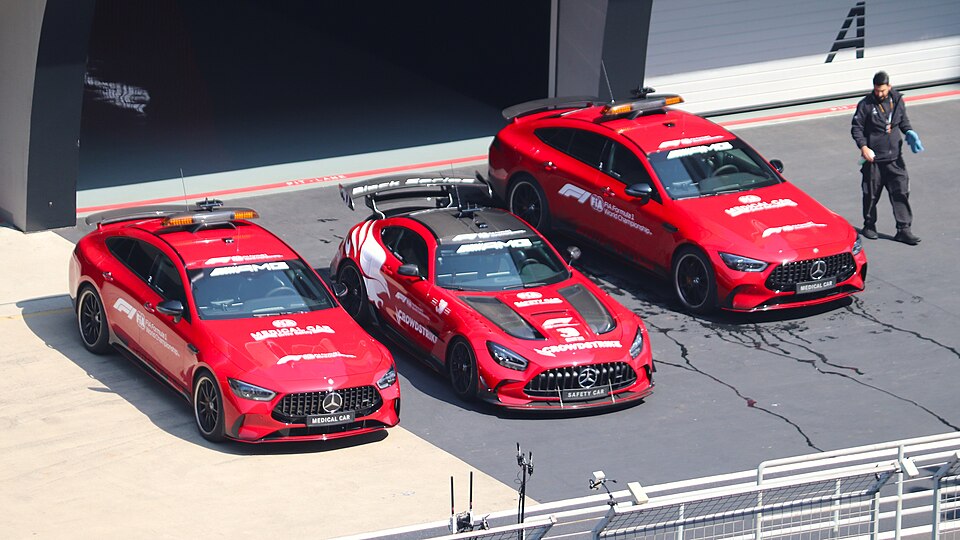
For 2026, Formula 1’s safety car procedures will undergo a fundamental transformation due to the new active aerodynamics system, which automatically defaults to ‘corner mode’ during safety car deployments to ensure convoy stability. This FIA-mandated setting locks all cars into high-downforce configuration, counteracting the challenges posed by the 2026 car’s 30kg weight reduction (minimum 768kg without fuel) and drastic aerodynamic changes—30% less downforce and 55% less drag compared to 2025. The lighter, less aerodynamically dependent cars require enhanced stability measures to prevent instability in the closely-packed safety car formation.
Complementing these changes are new front and rear rain lights for improved wet-weather visibility and lateral ERS status indicators that alert marshals to electrical hazards. Together, these innovations represent the most significant safety car procedural update in a decade.
- Active aerodynamics will force cars into high-downforce “corner mode” during safety car deployments for enhanced stability.
- New front and rear rain lights improve visibility in wet conditions during safety car restarts.
- Lateral ERS status lights help marshals identify electrical hazards when approaching crashed cars.
- Cars are ~30kg lighter with 30% less downforce and 55% less drag, changing handling and following dynamics behind the safety car.
Active Aerodynamics Will Control Car Stability During 2026 Safety Car Periods
Stability is critical at safety car speeds (typically 80-120 mph) because drivers are simultaneously managing multiple parameters: tire temperatures (shaped by Pirelli’s tire allocation strategies), brake temperatures, hybrid system charge levels, and fuel consumption. The 2026 cars’ 30% downforce reduction makes them inherently less stable in close proximity, as turbulent air from the leading car has a greater disruptive effect. Corner mode‘s consistent downforce load helps drivers maintain steady steering inputs and prevents sudden loss of grip that could cascade through the field.
Additionally, the corner mode setting keeps the cars’ aerodynamic balance stable, which is essential for drivers who may be adjusting brake bias or suspension settings during the slow lap. These active aero changes are part of the broader 2026 technical overhaul discussed in our article on Formula 1 Technical Regulations: 2026 Updates Explained.
Active Aerodynamics: Corner Mode Default for Safety Car Stability
Car Weight Reduction: 30kg Lighter, Minimum 768kg
| Weight Metric | 2025 Baseline | 2026 Regulation | Difference |
|---|---|---|---|
| Minimum weight (no fuel) | 798kg | 768kg | -30kg |
| Target operational weight | ~800kg | 770kg | -30kg |
| Weight reduction percentage | – | ~3.8% | – |
The 30kg weight reduction, equivalent to removing a full fuel load, significantly alters car dynamics during safety car periods. Lighter cars have lower momentum, meaning they brake more quickly and require less distance to slow from racing speed to safety car pace. However, this also makes them more sensitive to weight transfer during direction changes, potentially causing ‘nervous’ handling when drivers adjust position in the convoy.
The reduced mass means less tire load, which can lower mechanical grip, especially in cooler conditions when safety car periods often occur. Teams must recalibrate brake bias settings for safety car following, as the lighter front axle weight may cause front lock-ups more easily during the initial slowdown. Furthermore, the weight reduction combined with lower downforce increases the importance of precise throttle control to avoid wheelspin when accelerating out of corners on the restart lap.
Aerodynamic Changes: 30% Less Downforce, 55% Less Drag
| Aerodynamic Parameter | 2026 Change vs 2025 | Impact on Safety Car Operations |
|---|---|---|
| Downforce | -30% | Less cornering grip, more sensitive to turbulence |
| Drag | -55% | Higher top speed, faster acceleration on straights |
| Active aero modes | Corner/Straight toggle | Corner mode enforced during safety car for stability |
The 55% drag reduction will make 2026 cars substantially faster on straights, but the 30% downforce loss reduces the aerodynamic ‘glue’ that keeps cars planted in corners. During safety car periods, the enforced corner mode partially restores downforce, but the net reduction still means cars are less forgiving of driver errors and more affected by aerodynamic turbulence from the car ahead. This turbulence is particularly pronounced in the tightly-packed safety car convoy, where following distances shrink to a few car lengths.
Drivers may need to increase their following gap by 20-30% compared to 2025 to maintain stable aerodynamics. On restarts, the drag reduction becomes an advantage: when cars switch back to straight mode after the safety car returns, acceleration out of the final corner will be significantly quicker, potentially leading to more overtaking opportunities on the ensuing lap.
However, the lower downforce also increases the risk of wheelspin during aggressive acceleration, requiring drivers to modulate throttle more carefully. The acceleration characteristics on restarts mirror those seen in sprint races, as detailed in Formula 1 Sprint Race Format: How It Works and Its Impact on Championships.
What New Safety Features Will Be Used During 2026 Safety Car Deployments?
New Front and Rear Rain Lights for Wet Condition Visibility
- Primary purpose: Enhance visibility for drivers and track marshals during safety car deployments in wet weather, reducing collision risk when spray or rain limits sight lines.
- Installation: Mandatory front and rear rain lights on all 2026 F1 cars, providing 360-degree illumination that previous rear-only systems lacked.
- Operational benefit: Allows drivers to maintain tighter, safer following distances in the safety car convoy during rain, as the front lights clearly mark the car ahead’s position. Marshals also benefit when directing traffic or clearing incidents near the circuit.
The addition of these lights addresses a critical visibility gap: in heavy rain, drivers behind the safety car could previously only see the car ahead’s rear lights, which become obscured by spray. The new front-mounted lights, likely high-intensity LED arrays, pierce through precipitation to give a clear visual reference.
This is especially important during safety car restarts when the field accelerates from a standing start in wet conditions—drivers can immediately see the car in front’s position and react to its acceleration. The system will likely be integrated with the car’s existing lighting control unit and activated automatically when the safety car is deployed or when rain sensors detect precipitation intensity exceeding a threshold.
Lateral ERS Status Lights: Critical for Marshal Safety
The Energy Recovery System (ERS) in modern F1 cars stores electrical energy at voltages up to 1000V, posing a serious electrocution hazard to track marshals who may need to extract a driver from a crashed vehicle. The 2026 regulations introduce lateral safety lights—bright, color-coded indicators mounted on the sides of the survival cell—that instantly communicate the ERS status. A green light indicates the system is safe (discharged or isolated), while red signals that high voltage remains present.
During safety car deployments triggered by an accident, marshals approaching the incident can quickly assess the electrical risk from a distance without needing to physically inspect the car or rely on radio reports from the driver (who may be injured). This immediate visual cue allows rescue teams to decide whether to wait for specialized electrical safety personnel or proceed with extraction. The system is designed to be fail-safe: if the ERS status cannot be determined, the lights default to red to indicate potential danger.
This innovation directly addresses a safety concern raised after several incidents in the 2010s where marshals expressed caution around hybrid systems. The ERS is a core component of the 2026 power units, explained in Formula 1 Power Unit Technology: Hybrid Systems in 2026.
Strengthened Roll Hoop: 20G Impact Resistance
- Previous requirement: Roll hoops certified to withstand 16G lateral impact forces (approximately 16 times gravity).
- 2026 standard: Roll structures must survive 20G impacts—a 25% increase in load capacity.
- Testing protocol: The FIA conducts static and dynamic load tests on certified materials and assembly methods to ensure compliance.
While the roll hoop is a passive safety component not directly involved in procedural changes, its enhanced strength rating has indirect implications for safety car operations. A stronger roll structure increases the survival cell’s integrity in high-speed crashes that often prompt safety car deployments. This means drivers are more likely to emerge from severe impacts with only minor injuries, reducing the urgency of medical response and allowing marshals to focus on car recovery rather than emergency life support.
For safety car drivers and observers, knowing that the cars they are following have this enhanced protection provides additional confidence when responding to incidents. The 20G standard also reflects the FIA’s commitment to continuous safety improvement, acknowledging that modern F1 cars, despite being lighter, must maintain or exceed previous crashworthiness levels.
The mandatory corner mode during safety car periods creates a paradoxical effect: while it stabilizes the field, it also slows the entire convoy more than in previous years. This extended slow-speed lap causes tire and brake temperatures to drop significantly, often requiring drivers to manage tire warm-up aggressively on the restart. The resulting tightly-bunched formation, combined with the 2026 cars’ reduced downforce, means aerodynamic turbulence is severe on the first lap after the safety car.
However, the 55% drag reduction becomes a major advantage once cars switch back to straight mode—acceleration out of the final corner is dramatically quicker, potentially creating more overtaking opportunities on the lap immediately following the safety car period than we saw in the hybrid era. Teams that perfect the transition timing from corner mode to straight mode could gain multiple positions in the first two corners after the restart.
To exploit these dynamics, F1 teams must integrate safety car scenario training into their 2026 simulator programs. Drivers should practice the exact moment to toggle from corner mode to straight mode—ideally as the safety car crosses the pit lane entry line—to maximize acceleration while avoiding wheelspin. Engineers need to collect data on tire temperature decay rates during safety car laps with the new aero settings to optimize restart tire pressures and blanket configurations.
Additionally, teams should simulate merge procedures behind the safety car with the 30kg lighter cars to determine optimal following distances that prevent collisions while maintaining aerodynamic stability. With the budget cap limiting testing resources, teams must prioritize simulator scenarios effectively—see Formula 1 Budget Cap: Financial Fair Play in Motorsport for how financial constraints shape preparation. For a deeper dive into professional racing strategies and career development, explore Sarah Moore Racing’s comprehensive resources on professional racing.
