
NASCAR pit crews execute sub-10-second stops through precise coordination and specialized equipment, with top teams averaging 12-15 seconds for four-tire changes and fueling. The absolute record for a four-tire stop is 8.02 seconds, achieved by Denny Hamlin’s crew in May 2025. These rapid stops are essential for gaining track position during races, an advantage that drivers can further leverage with NASCAR drafting techniques.
This guide explores the techniques, strategic decisions, and record-breaking performances that define modern professional racing pit stop operations. Understanding these elements reveals how fractions of seconds determine race outcomes.
- Top-tier NASCAR Cup Series teams average 12-15 seconds for four-tire pit stops, while elite crews break the 10-second barrier.
- The record for the fastest four-tire stop is 8.02 seconds, set by Denny Hamlin’s crew in May 2025.
- Two-tire stops typically last 8-10 seconds, offering a faster alternative when tire wear is minimal.
- Specialized equipment like air guns and dedicated crew roles (e.g., jackman) are essential for achieving sub-10-second stops.
Achieving Sub-10-Second Pit Stops: Techniques and Timing
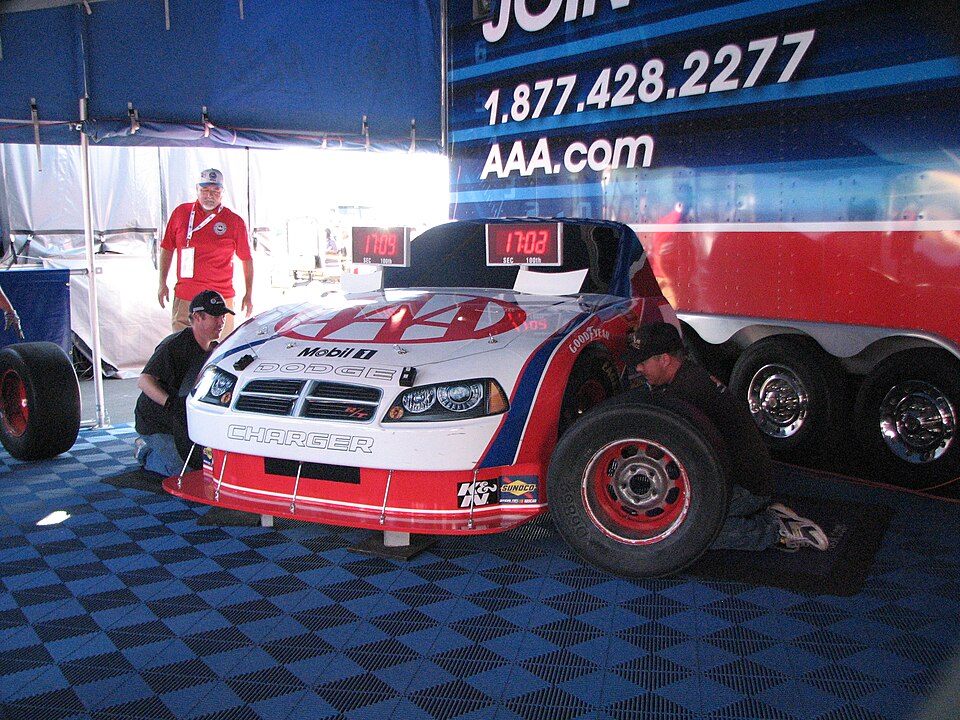
Current Performance Benchmarks: 12-15 Seconds for Four-Tire Stops
| Stop Type | Average Time | Fastest Record | Typical Crew |
|---|---|---|---|
| Four-tire + fuel | 12-15 seconds | 8.02 seconds | 5-6 members |
| Two-tire only | 8-10 seconds | Not separately tracked | 5-6 members |
These benchmarks illustrate the dramatic evolution of pit stops from minute-long operations in the 1990s to today’s sub-10-second feats. The 12-15 second average for four-tire stops represents the current standard for top-tier Cup Series teams. However, the 8.02-second record set by Denny Hamlin’s crew reveals the potential when every element aligns perfectly.
The 3-5 second gap between average and elite crews translates directly into track position—often enough to gain 5-10 places during a race. Joe Gibbs Racing has consistently operated at the elite level, demonstrating that sustained excellence requires investment in technology, training, and athlete development. This performance gap mirrors the margins seen in other motorsports, such as the Formula 1 technical regulations where aerodynamic efficiency separates front-runners from the pack.
Elite Speed: Breaking the 10-Second Barrier and the 8.02-Second Record
Breaking the 10-second barrier demands flawless execution across all crew positions. Each member must perform their task in under 1.5 seconds while maintaining absolute safety. The record 8.02-second stop by Denny Hamlin’s crew in May 2025 stands as the gold standard.
This achievement reflects years of refinement in equipment design and choreography. Crew members undergo specialized athletic training focusing on explosive movements and reaction times. The jackman, for instance, must lift a 3,500-pound car in exactly one second—a feat requiring both strength and precision.
In March 2026, Kyle Busch’s crew maintained sub-12-second stops at the Duramax Grand Prix, proving that consistency is as valuable as a single record. Both crews belong to Joe Gibbs Racing, a team that has institutionalized pit stop excellence through shared training protocols and equipment standards. These elite performances create a performance gap that separates championship contenders from mid-field teams, much like how Formula 1 power unit efficiency determines race competitiveness.
Two-Tire Stops: 8-10 Seconds and Their Strategic Use
- Typical duration: 8-10 seconds
- Time advantage: 2-4 seconds faster than standard four-tire stops
- Optimal conditions: Minimal tire wear, caution periods, when track position is critical
- Strategic trade-off: Immediate position gain vs. potential performance loss later
- Risk factor: May require an additional stop sooner than four-tire option
- Track-specific considerations: Short tracks often favor two-tire stops due to less tire wear; superspeedways may use two-tire to gain drafting position
- Fuel integration: Adding fuel to a two-tire stop can extend time to 10-12 seconds, narrowing the advantage
Two-tire stops offer a tactical shortcut to improve track position with minimal time penalty. Teams frequently employ this strategy during caution periods when the field is frozen, allowing them to gain positions without losing relative time. The decision hinges on data: tire wear sensors, fuel remaining, and lap count.
A two-tire stop with fuel might take 10-12 seconds, still faster than a full four-tire service. However, the reduced tire compound can degrade 15-20% faster, potentially costing positions in the final stint.
Smart teams use two-tire stops when the immediate position gain outweighs the long-term performance cost. This strategic calculus is similar to Formula 1 tire compound strategies, where tire choice balances immediate speed with longevity.
Technology and Crew Roles: Air Guns, Specialized Equipment, and the Jackman
Modern pit stops rely on technology that transforms human athletes into precision instruments. Pneumatic air guns deliver torque with millimeter accuracy, removing and tightening lug nuts in 0.8-1.0 seconds. These guns are custom-built for each team, with specifications fine-tuned to the exact torque requirements of the wheel nuts.
Specialized jacks lift 3,500-pound cars in exactly one second using hydraulic systems that must withstand repeated stress without failure. Each crew member occupies a specific zone: the jackman lifts the car, tire changers work in synchronized pairs (front and rear), and the “lollipop” man controls pit box entry/exit. Kellen Mills, a jackman from Mesa, Arizona, exemplifies the athleticism required—these crew members undergo strength and conditioning programs rivaling the drivers’.
The integration of technology and human skill is non-negotiable for sub-10-second stops. Equipment failures or miscommunication add 2-3 seconds instantly, ruining race strategy.
This is why top teams invest millions in pit crew training facilities and custom equipment. The evolution of this technology parallels advancements in Formula 1 sprint race formats, where every millisecond counts.
Pit Stop Strategy: Tire and Fuel Decisions for Track Position
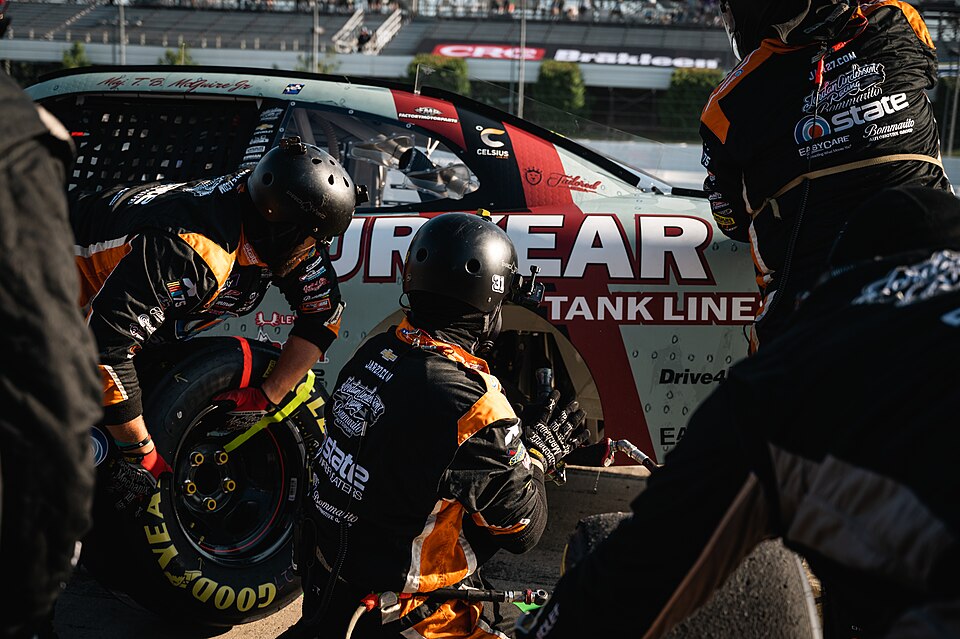
Four-Tire vs Two-Tire: Time Trade-Offs and When to Choose Each
- Time differential: Two-tire stops 8-10 seconds vs. four-tire average 12-15 seconds
- Elite four-tire stops can approach 8-10 seconds (record: 8.02s)
- Strategic variables: Track surface grip, tire wear data, fuel needs, race position, laps remaining
- Four-tire benefits: Optimal performance, longer tire life, fewer total stops
- Two-tire benefits: Immediate track position gain, flexibility in race strategy
- Short track strategy: Often two-tire stops due to less tire wear and importance of track position
- Superspeedway strategy: Two-tire stops common to gain drafting position quickly
- Road course strategy: Four-tire stops more frequent due to varied tire wear across corners
- Fuel window integration: Teams calculate when fuel needs force a stop, then choose tire strategy accordingly
The 8.02-second four-tire record proves that with optimal execution, full service can match the speed of a two-tire stop. This challenges conventional wisdom that fewer tires always mean faster stops. Teams must evaluate the entire race context: a two-tire stop might gain 3 positions immediately but cost 8 positions later due to inferior grip.
In the final 50 laps, a two-tire stop could be decisive; early in the race, four tires often prove more advantageous. Fuel needs complicate the decision—adding fuel to a two-tire stop might push it to 12-14 seconds, eliminating the time advantage.
The best teams make these calculations based on real-time data and historical performance at specific tracks. This strategic depth is what separates championship-caliber crew chiefs from the rest.
Fueling as a Standard Component: Why High-Performance Stops Include Refueling
Refueling adds 2-3 seconds to a pit stop, yet it remains standard in virtually all high-performance stops. This is because fuel strategy is inseparable from tire strategy. Teams cannot skip refueling without compromising race distance or forcing an extra stop later, which would cost more time overall.
The choreography of modern stops integrates fueling seamlessly—while the fuel man connects the rig, other crew members change tires. The average 12-second four-tire stop with fuel represents the optimal balance: fresh tires for immediate performance and sufficient fuel to reach the next strategic window. Skipping fuel to save time is rarely advantageous in modern NASCAR, where fuel mileage is calculated to the ounce.
Teams that attempt “quickie” stops without fuel often find themselves pitting again within 20-30 laps, negating any initial gain. The inclusion of refueling in elite stops, even at the record 8.02-second pace, demonstrates that comprehensive service is the championship standard.
Fuel rigs themselves are technological marvels, capable of pumping up to 12 gallons per second with precise metering to avoid spillage penalties. This integration of fueling into the stop choreography is a key differentiator between good and great pit crews.
2025-2026 Record-Breaking Pit Stops: Teams and Milestones
Denny Hamlin’s Crew Sets All-Time Record: 8.02-Second Stop (May 2025)
In May 2025, Denny Hamlin’s crew achieved the seemingly impossible: an 8.02-second four-tire stop during the Coca-Cola 600 at Charlotte Motor Speedway. This record shattered previous benchmarks and redefined what was thought possible in pit stop performance. The stop occurred during a green-flag pit cycle, providing Hamlin with a massive track position advantage that contributed to his eventual victory.
Joe Gibbs Racing, the team behind this feat, has long been recognized for pit crew excellence, but this record cemented their status as the industry benchmark. The 8.02-second mark represents the culmination of years spent optimizing equipment specifications, refining choreography, and developing crew athletes.
Crew chief Chris Gayle attributed the success to “perfect synchronization” and “new gun torque settings” that reduced lug nut engagement time by 0.3 seconds. This single stop influenced how all teams approached pit stop training and equipment investment in the 2026 season, raising the performance ceiling across the board.
Kyle Busch’s Crew and the 2026 Duramax Grand Prix: Sub-12-Second Stops at Circuit of the Americas
- Consistent performance: Sub-12-second stops throughout the March 2026 event
- Location: Circuit of the Americas, a road course that challenges pit crews with diverse conditions
- Event: Duramax Grand Prix, a marquee race on the NASCAR calendar
- Team: Kyle Busch’s crew, also part of Joe Gibbs Racing
- Significance: Demonstrates reliability across entire race distance, not just single stops
- Average time: 11.4 seconds for four-tire stops with fuel
- Fastest stop: 10.9 seconds under road course conditions
Kyle Busch’s crew delivered exceptional consistency at the March 2026 Duramax Grand Prix at Circuit of the Americas, executing sub-12-second stops from green flag to checkered flag. This road course, with its 20 turns and varying pit lane entry angles, presents unique challenges that typically slow pit times by 1-2 seconds compared to oval tracks. The crew’s ability to maintain sub-12-second performance under these conditions demonstrated remarkable adaptability.
Throughout the race, they averaged 11.4 seconds for four-tire stops with fuel, with their fastest stop clocking 10.9 seconds. This reliability ensured Busch remained in the top 5 throughout the event, ultimately finishing second. Both the and crews belong to Joe Gibbs Racing, highlighting the team’s dominance in pit stop performance.
Their success stems from shared training protocols, standardized equipment, and a culture that treats pit stops as a championship-winning element equal to car speed. This dual-crew excellence provides a strategic advantage that few teams can replicate, as both cars benefit from the same pit stop philosophy and execution standards. The performance also underscored how budget allocation to pit crew development yields measurable on-track results.
The most surprising finding is that elite four-tire stops can match the speed of two-tire stops, challenging the assumption that fewer tires always mean quicker service. The 8.02-second record by Denny Hamlin’s crew proves that with optimal technology and choreography, the time penalty for full service virtually disappears. For teams seeking improvement, the specific action is to study the equipment specifications and movement patterns of record-setting crews like the #11.
Focus on gun torque settings, jack lift synchronization, and crew positioning. These measurable details reveal the 2-3 second gaps that separate good crews from great ones. Implementing even one optimization from these benchmarks can yield significant track position gains over a season.
