
NASCAR drafting techniques are aerodynamic methods where a trailing car follows closely behind a leader to reduce air drag, gaining a speed advantage of 5+ mph (SimScale, 2024). This slipstream effect allows drivers to execute overtakes more easily, especially on superspeedways.
The primary purpose is to gain speed for passing by minimizing aerodynamic resistance. These techniques are fundamental to NASCAR racing strategy and can be the difference between winning and losing on tracks like Daytona and Talladega, as demonstrated by drivers in Sarah Moore Racing.
- Drafting reduces drag by 20-30% for the trailing car (Spence, 2009).
- Slingshot passes use momentum from the draft to overtake the leader (HowStuffWorks).
- Side drafting disrupts the leader’s rear airflow, slowing them for easier passes (SimScale, 2024).
Three Essential NASCAR Drafting Techniques for Overtaking
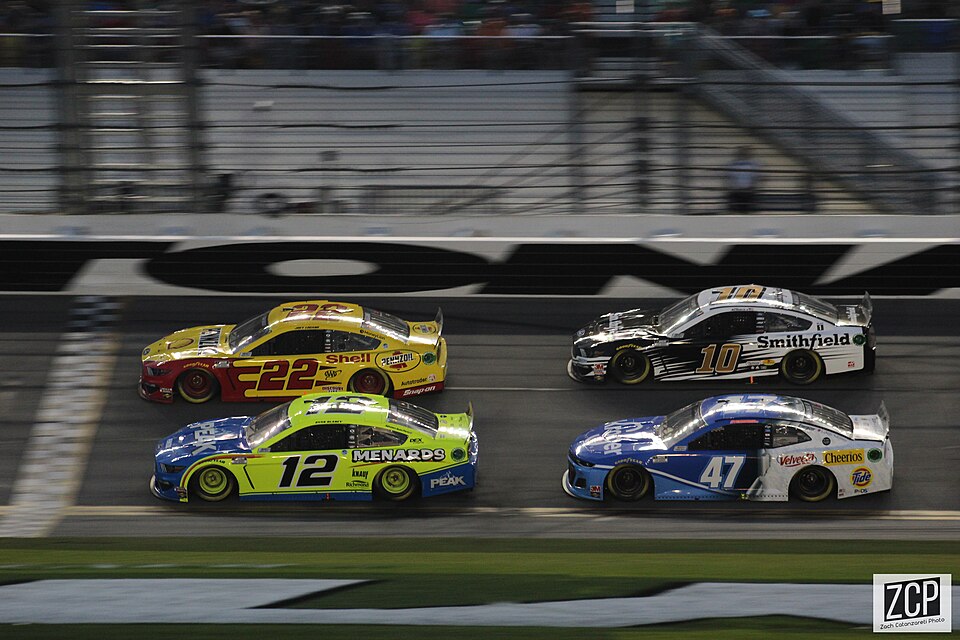
Slingshot Overtake: Building Momentum to Pass the Leader
- Follow in the draft: The trailing car tucks closely behind the leader, entering the low-pressure slipstream. This reduces aerodynamic drag by 20-30% for the follower (Spence, 2009), allowing the trailing car to build speed while conserving energy.
- Build momentum: While in the draft, the trailing car gains speed continuously, often reaching 5+ mph faster than the leader (SimScale, 2024). This momentum is stored as kinetic energy.
- Pull out before a turn: As it approaches a corner, the trailing car pulls out of the draft into clean air. This is the critical moment: the trailing car has accumulated a momentum advantage.
- Surge past the destabilized leader: With the momentum from the draft, the trailing car can accelerate past the leader. The leader, now without the trailing car’s aerodynamic benefit, experiences increased drag and may become unstable, making the pass easier.
- Execute the pass: The trailing car uses the surplus speed to take the lead, often on the outside of the turn, and then can re-enter the draft if needed to maintain the position.
Side Drafting: Disrupting Rear Airflow to Slow the Leader
Side drafting is a technique where the trailing car moves alongside the leader, particularly on the outside, to disrupt the airflow over the leader’s rear wing and spoiler. This disruption creates turbulent air that reduces downforce, causing the leader’s car to understeer and lose speed. The trailing car’s nose or front fender interferes with the smooth airflow that normally attaches to the leader’s rear aerodynamic elements, generating ‘dirty air’ that compromises handling.
In the 2024 NASCAR Cup Series, side drafting became a key strategic move, especially on intermediate tracks like Atlanta. Drivers used it to gain positions without full-contact bump drafting, making it a safer alternative. This technique is a hallmark of professional racing, where precision and aerodynamic understanding are paramount.
By targeting the leader’s rear stability, the side-drafter can force a mistake or create an opening for a pass, all without physical contact. Unlike traditional drafting, which requires following directly in the slipstream, side drafting can be done from a slightly offset position. This offset reduces the trailing car’s exposure to turbulent air, mitigating the aero push that would otherwise cause understeer.
As a result, side drafting is particularly valuable on intermediate tracks where aero push is a concern. The technique was widely discussed on platforms like TikTok and Instagram in 2024, with fans and analysts breaking down its impact on race outcomes.
Bump Drafting: The Mutual Speed Boost and Its 2014 Ban
- Definition: Bump drafting involves the trailing car making light contact with the leader’s rear bumper to push the leader forward, while both cars gain a mutual speed boost from reduced drag.
- Safety concerns: The practice was banned by NASCAR in 2014 (NASCAR.com, 2014) because it caused instability and high-speed crashes, especially on superspeedways. The contact could lead to sudden spins or multi-car wrecks.
- Tandem drafting distinction: Tandem drafting, where two cars lock together and push each other for extended periods, was also banned after the 2013 season due to multiple wrecks. Bump drafting is a single, lighter touch, while tandem involves sustained contact.
-
Impact of the ban: After the ban, drivers shifted to side drafting and slingshot techniques, which rely on aerodynamic disruption rather than physical contact.
This change improved safety but also altered racing strategies on superspeedways, making overtaking more dependent on driver skill and car control.
-
Pre-ban era: Before the ban, bump drafting was common at Daytona and Talladega, where packs would often see cars bump-drafting to maintain high speeds. The practice led to several major accidents, including multi-car wrecks that raised safety concerns.
NASCAR’s prohibition of bump drafting forced teams to develop new overtaking techniques, such as the slingshot and side drafting, which rely solely on aerodynamic effects without contact. Today, any intentional contact is penalized, and drivers must use finesse rather than force to pass.
How Does Drafting Create a 5+ MPH Speed Advantage?
Drag Reduction: 20-30% Advantage in the Slipstream
Without drafting, a car faces high aerodynamic drag as it cuts through the air alone. With drafting, the trailing car enters the leader’s slipstream—a region of low-pressure wake—where air resistance is reduced. This drag reduction amounts to 20-30% for the trailing vehicle (Spence, 2009).
The slipstream effect works because the leader’s body displaces air, creating a turbulent, low-density zone behind it. The trailing car experiences less dense air, which lowers drag forces and allows higher speeds with the same engine power. The aerodynamic principles behind drafting are universal; in Formula 1, the Formula 1 technical regulations 2026 specifically address how cars generate and manage downforce, which is the opposite of drag reduction.
The reduction in drag directly translates to a significant speed advantage. For example, at superspeedway speeds of around 200 mph, the 20-30% drag reduction can yield a 5+ mph increase in velocity (SimScale, 2024). This effect is most pronounced when the trailing car is very close to the leader, typically within one car length.
The closer the proximity, the greater the drag reduction, but also the higher the risk of losing control due to turbulent air. Therefore, drivers must balance the benefit of drafting with the need for stability.
While drafting improves efficiency, raw speed also comes from power units. Formula 1’s power unit technology showcases the pinnacle of hybrid engine design, demonstrating how power and aerodynamics combine for ultimate performance.
Speed Gains: 5+ MPH at Superspeedway Speeds
The speed advantage from drafting is quantifiable, with specific gains observed in different racing scenarios. The following table summarizes key findings from recent analyses:
| Scenario | Speed Gain | Source |
|---|---|---|
| Trailing car in draft | 5+ mph | SimScale, 2024 |
| Pack racing at Daytona 500 (~200 mph) | Packs run faster together than solo | HowStuffWorks |
These data points demonstrate that drafting is not merely a theoretical concept but a practical speed booster. The 5+ mph advantage may seem modest, but at superspeedway speeds where every mile per hour counts, it can determine overtaking success. The pack racing phenomenon at Daytona shows that when multiple cars draft together, the collective effect can lead to even higher speeds, creating the famous ‘big pack’ racing that defines events like the Daytona 500.
This is why drafting is absolutely essential on superspeedways and why teams invest heavily in understanding aerodynamic interactions. Speed gains also depend on tire grip; in Formula 1, tire compound strategy determines how much mechanical grip a car has, affecting overall lap times and how effectively drafting can be utilized.
Track-Specific Drafting Strategies: Superspeedways vs Intermediates
Superspeedway Dominance: Daytona and Talladega
- Long straights: Superspeedways like Daytona and Talladega feature extensive straightaways where cars maintain high speeds for extended periods, allowing drafting to be fully effective.
- High speeds: At speeds around 200 mph, aerodynamic drag becomes the dominant force opposing motion. Drafting reduces this drag significantly, making speed gains more substantial.
- Minimal aero push: On superspeedways, the banking and track design minimize the ‘aero push’ effect (understeer from lost downforce) that plagues intermediate tracks, so trailing cars can follow closely without handling penalties.
- Packs run faster: As noted by HowStuffWorks, at Daytona 500 speeds, packs of drafting cars actually run faster together than a single car could alone, creating a symbiotic speed boost.
- Essential for competition: Without drafting, cars would spread out and race singly, reducing the close competition that fans expect. The ability to master drafting techniques like the slingshot is what separates winners from the field at Daytona and Talladega.
Intermediate Challenges: Aero Push and Atlanta’s Exception
On intermediate tracks (1-2 miles in length), drafting becomes more challenging due to the ‘aero push’ phenomenon. When a car follows closely behind another, it loses clean air and encounters turbulent air that reduces downforce.
This loss of downforce causes understeer—the front tires lose grip, making the car turn less effectively. As a result, trailing cars must often back off to maintain control, reducing the effectiveness of drafting compared to superspeedways.
However, Atlanta Motor Speedway presents an exception. Despite being an intermediate track, Atlanta’s high banking and configuration make it a ‘side drafting heaven’ (Speed Channel, 2010).
Here, drivers use side drafting to disrupt the leader’s rear aerodynamics without following directly in the slipstream, avoiding the worst of the aero push. This technique is crucial in the Formula 1 sprint race format, where aerodynamic battles are intense over shorter distances.
The trade-off is that side drafting requires precise positioning and carries less speed benefit than traditional drafting on superspeedways. Even with financial constraints like the Formula 1 budget cap, teams invest in aerodynamic research to minimize dirty air, highlighting the importance of these techniques across motorsports.
Most surprising insight: drafting is not just about speed but also about destabilizing the leader’s car. The slingshot and side drafting techniques exploit aerodynamic vulnerabilities to force errors. Action step: practice slingshot timing on racing simulators to master the pull-out moment before turns.
Simulators like those used by NASCAR teams allow drivers to experiment with drafting in a safe environment, building muscle memory for real races. Additionally, study footage of recent Cup Series races to see how drivers like Kyle Larson and Denny Hamlin execute these moves.
Understanding the 20-30% drag reduction and 5+ mph speed gain will help you appreciate why drafting is a cornerstone of NASCAR strategy on superspeedways. While drafting gains track position on track, NASCAR pit stop strategies also play a critical role in overall race outcomes.
